A mechanical keyboard switch that sounds muted in a test fixture may produce a sharp clack once installed in an aluminum-plate keyboard. The switch has not changed, but its vibration path has.
For keyboard manufacturers, this creates a challenge when designing acoustic switches. While milky nylon housings have been associated with a rounded, relatively subdued sound, the housing material alone does not determine the complete sound profile of a switch.
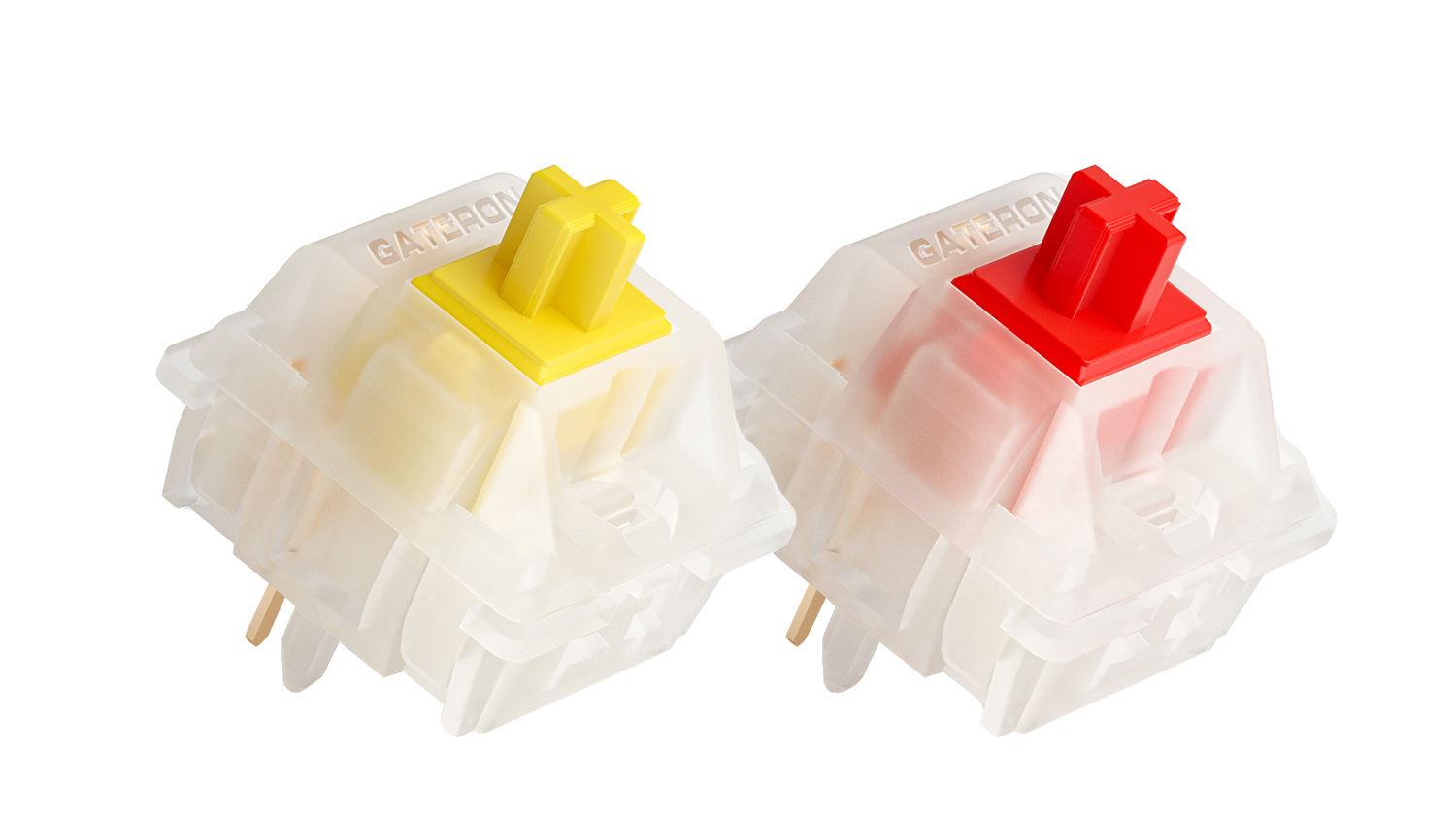
GATERON's KS-3 Milky Pro has both milky nylon upper and lower housings, a POM stem, and factory lubrication. To study the acoustic behavior of this switch, engineers need to decouple the effects of material damping from stem impacts and consider internal friction and resonances in the assembled keyboard.
1. Why Does Milky Nylon Change Mechanical Keyboard Switch Sound?
A linear switch makes sound via stem impacts. Bottoming out occurs when the stem touches the lower limit of its travel, and topping out occurs when the stem comes in contact with the upper limit of its travel.
Impacts of the stem on the housing and keyboard structure can excite resonant vibrations and leave substantial residual vibrational energy. This vibrational energy is in turn transferred to housings of neighboring switches, keyboard frames and other parts connected to them via mechanical impedance.
Some nylon formulations may exhibit a weaker strong high-frequency response when compared to other stiffer engineering plastics. Differences in housing shape, polymer grade, fillers, and process conditions may account for variance in audio response.
Milky Appearance Is Not an Acoustic Specification
The housing has a milky appearance due to its optical characteristics. Translucency does not always denote damping performance.
Nylon also absorbs moisture, which changes its dimensions and mechanical properties. For fair comparisons of different materials, test samples must be conditioned at a controlled temperature and relative humidity.
Describing a switch as creamy or thocky reflects a subjective interpretation of its sound, rather than a measured frequency response.
2. What Is the Effect of POM Stems and Factory Lubrication?
As mentioned above, impact and sliding noises in the Gateron KS-3 Milky Pro can be influenced by its POM stem, housing design, and lubrication.
POM exhibits low friction and good wear resistance; hence, it is used in sliding elements. The restrictions provided by the housing limit the free movement of the stem.
Excessive clearance allows lateral movement. Under off-center keypresses, the stem may contact the walls of the guide asymmetrically, causing a rattle or other impact noises.
Insufficient clearance creates another problem: dimensional variation, contamination, or material expansion may increase sliding resistance.
Lubrication Suppresses Friction, Not Bottom-Out
KS-3 Milky Pro switches are factory pre-lubricated. Lubricant can reduce friction-related noise at contact interfaces, particularly during slow stem movement.
It can't get rid of the mechanical impact at the end of travel.
Lubrication issues may cause switches to make different sounds, even when they have the same design. Too little lubricant may cause scratching, and too much may cause drag or uneven return.
When looking for an acoustic defect, engineers look for the sound source before changing the amount of lubricant.
|
Observed Sound
|
Possible Mechanical Source
|
Practical Verification
|
|
Sharp bottom-out clack
|
Stem impact and structural resonance
|
Compare controlled bottom-out recordings
|
|
High release tick
|
Top-out contact
|
Record release separately from depression
|
|
Scratchy movement
|
Sliding friction, surface defects
|
Inspect guides and test slow actuation
|
|
Metallic ringing
|
Spring vibration
|
Compare individual switches
|
|
Irregular rattle
|
Lateral clearance, unstable mounting
|
Test off center actuation
|
These are possible causes of the observed sounds, not confirmed defects in GATERON switches.
3. Does Spring Force Make Milky Red Pro and Yellow Pro Sound Different?
The KS-3 Milky Pro Red and Yellow versions share the same specified housing and stem materials but differ in nominal operating force.
|
Specification
|
Milky Red Pro
|
Milky Yellow Pro
|
|
Switch mechanism
|
Linear
|
Linear
|
|
Operating force
|
45 ± 15 gf
|
50 ± 15 gf
|
|
Pre-travel
|
2.0 ± 0.6 mm
|
2.0 ± 0.6 mm
|
|
Total travel
|
4.0 mm
|
4.0 mm
|
|
Housing
|
Milky nylon
|
Milky nylon
|
|
Stem
|
POM
|
POM
|
The higher nominal operating force of Yellow Pro changes the force required to move the stem through its actuation point.
However, operating force is not equivalent to bottom-out force. The complete force-displacement curve, including spring preload and progression, determines resistance throughout travel.
Impact velocity matters as well. A user may press a heavier switch differently from a lighter one, changing the acoustic result even when the housing construction is identical.
The published operating-force tolerance ranges overlap. Consequently, the nominal 5 gf difference should not be interpreted as proof of a consistently measurable sound difference.
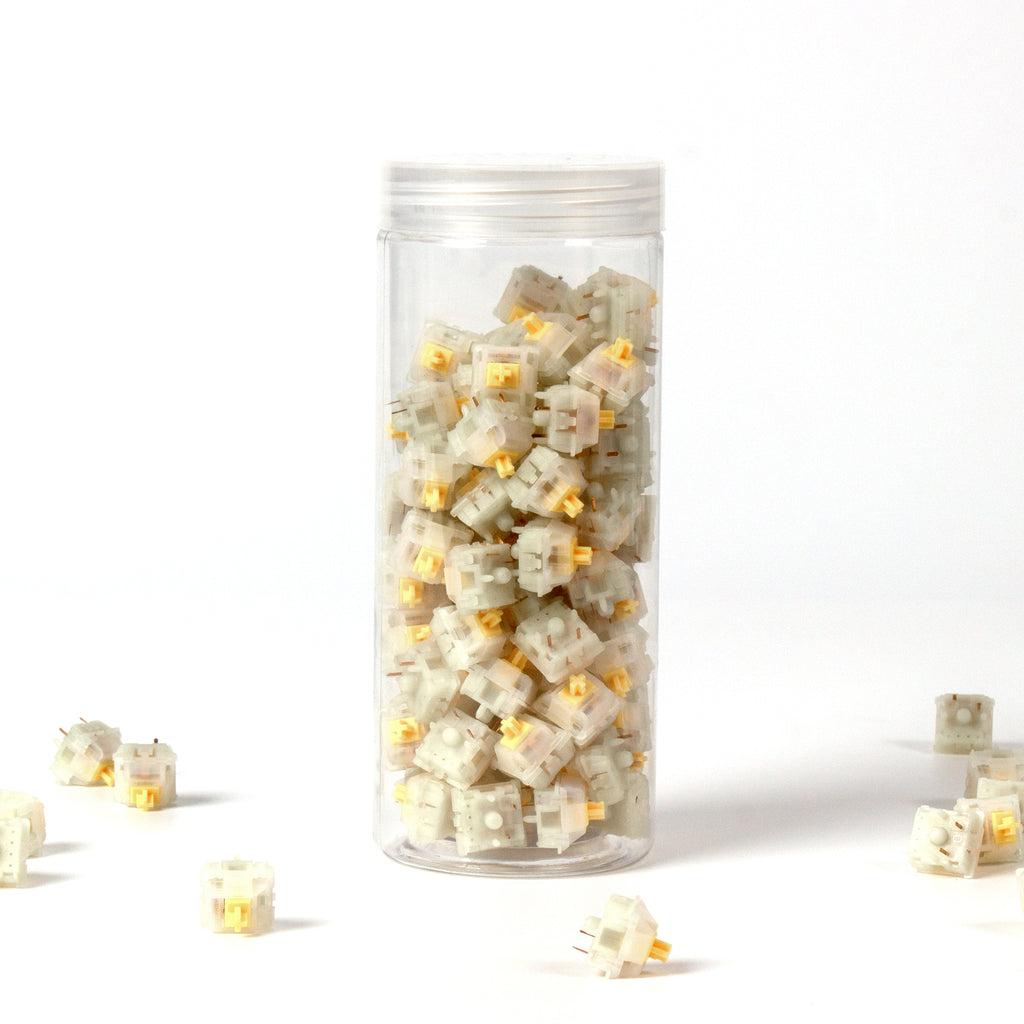
Compare procurement alternatives under controlled actuation and representative human typing conditions.
4. Why Can the Same Nylon Switch Sound Different Across Keyboard Designs?
The housing creates and transmits vibration, but the surrounding assembly determines much of the sound that reaches the listener.
An aluminum plate and a polycarbonate plate have different stiffness and damping behavior. Their influence also depends on thickness, geometry, and mounting constraints.
Similarly, a rigid tray-mounted keyboard transfers impact energy differently from a compliant gasket-mounted assembly.
Another variable is keycap geometry. The wall thickness, profile, and the shape of the internal cavity can change the sound radiated during the impact.
Case resonance may further amplify specific frequencies. Adding damping material can suppress cavity-related ringing, but it does not necessarily eliminate sharp stem impacts.
For an OEM project, acoustic approval based on a loose-switch recording is therefore inadequate. The relevant measurement is the switch installed in the intended keyboard construction.
5. How Should OEM Buyers Verify Acoustic Consistency?
Switch selection should separate three questions: Does the product meet the desired sound profile? Is that profile consistent between samples? Does it remain acceptable after use?
A qualification procedure includes:
- Control the assembly. When comparing switch candidates, use the same keycaps, plate, case, desk surface, and mount.
- Standardize actuation. Specify conditions for press and release. Document bottom-out and top-out, if possible.
- Evaluate spectral behavior. Measure sound pressure levelsand capture transient waveforms and frequency spectra. Be sure to use the same microphone positioning for all measurements.
- Check variation and aging. Sample multiple switches. Measure the same thing after cycling and environmental conditioning. Sample different production lots.
Measurements should be accompanied by listening evaluations under realistic typing conditions. A lower measured sound-pressure level does not automatically mean a switch sounds deeper or more pleasant.
For production acceptance, buyers should also confirm permitted acoustic variation, inspection sampling, and the treatment of intermittent spring noise or housing rattle. These requirements need agreement rather than assumptions based on promotional sound descriptions.
Evaluating GATERON KS-3 Milky Pro
The GATERON KS-3 Milky Pro provides a defined construction starting point: both nylon upper and lower housings, a POM stem, factory lubrication, and 5-pin mounting. Its final acoustic performance still requires verification in the target keyboard.
For switch selection and product details, review the GATERON KS-3 Milky Pro Switch Set before proceeding with assembly-level acoustic testing.
FAQs
Q1. What makes GATERON Milky Pro switches sound different?
GATERON Milky Pro switches use nylon housings that influence vibration transmission and damping. The final sound also depends on stem impacts, lubrication, keycaps, and keyboard construction.
Q2. What materials are used in GATERON KS-3 Milky Pro switches?
The KS-3 Milky Pro uses milky nylon upper and lower housings, a POM stem, and a spring made of steel.
Q3. Are GATERON KS-3 Milky Pro switches factory-lubed?
Yes. GATERON KS-3 Milky Pro switches are factory pre-lubricated to reduce sliding friction and improve typing smoothness.
Q4. Do milky nylon housings make mechanical switches quieter?
Not necessarily. Nylon's damping properties can influence resonance, but bottom-out force, housing geometry, and keyboard construction determine the actual noise level.
Q5. What is the difference between GATERON Milky Red Pro and Yellow Pro?
Milky Red Pro has a nominal operating force of 45 ± 15 gf, while Yellow Pro is rated at 50 ± 15 gf. Both are linear switches with 4.0 mm total travel.


