A keyboard manufacturer replacing KS-33 2.0 switches with 3.0 may encounter a problem before the first keystroke: the replacement does not necessarily fit the existing PCB. Even when mounting is compatible, changes in travel limits and spring force can alter the typing feel.
Gateron's Low Profile Mechanical Switches 2.0 vs 3.0 comparison therefore comes down to three engineering questions: what changes mechanically, whether those changes affect electrical actuation, and which dimensions must be requalified before production.

1. What Actually Changed in the KS-33 Specifications?
The most noticeable revision is the available total travel. The standard 3.0 variants specify longer maximum strokes than their 2.0 counterparts, although their nominal pre-travel remains unchanged.
|
KS-33 Variant
|
Operating Force 2.0 / 3.0
|
Pre-Travel (Both)
|
Total Travel 2.0 / 3.0
|
|
Red, Linear
|
50 / 50 ±15 gf
|
1.7±0.4 mm
|
3.2 / 3.4 mm
|
|
Brown, Tactile
|
55 / 55 ±15 gf
|
1.7±0.4 mm
|
3.2 / 3.4 mm
|
|
Silver, Linear
|
50 / 43 ±15 gf
|
1.2±0.3 mm
|
3.2 / 3.5 mm
|
|
Blue, Clicky
|
65 / 60 ±15 gf
|
1.7±0.4 mm
|
3.2 / 3.5 mm
|
Operating force values are nominal, each with a ±15 gf tolerance. The 3.0 travel figures are published as maximum values; the standard 2.0 product documentation also specifies a ±0.2 mm total-travel tolerance. Actual stroke comparisons require consistent measurement criteria.
Red and Brown preserve their nominal operating forces. Silver drops from 50 gf to 43 gf, while Blue changes from 65 gf to 60 gf.
These figures describe different spring and travel configurations, not a blanket improvement in responsiveness. The specified force ranges overlap substantially, so nominal force alone cannot predict how distinctly two production samples will feel.
2. Does the Longer Travel Improve Typing Performance?
Actuation and Bottom-Out Are Separate Events
In a mechanical switch, electrical actuation occurs before the stem reaches its mechanical stop.
For KS-33 Red, both generations specify 1.7 mm nominal pre-travel. The 3.0 version allows up to 3.4 mm of total travel, compared with the 2.0 generation's published 3.2 mm figure.
The additional available stroke lies principally after actuation. It can change the sensation of a fully depressed key, but it does not establish earlier electrical registration.
This distinction becomes relevant in compact keyboards, where keycap clearance and bottom-out behavior are tightly constrained.
Three conditions deserve attention:
- Hard bottom-out: A sudden stop can concentrate impact energy into the housing, plate, and PCB assembly.Different stroke limits can affect the resulting sound and feel.
- Accidental actuation: Some users may find the lighter nominal force of 3.0 Silver switches to their liking, butitmay lead to unintended actuation depending on an individual's typing style and finger resting pressure.
- Release consistency: For rapid repeated inputs, the behavior of the magnetic sensing system and spring return play a role in addition to total travel.
Neither generation's published travel specifications establish lower input latency. That requires electrical timing measurements under identical keyboard controller conditions.
3. Have the Materials and Stem Guidance Changed?
Gateron's KS-33 2.0 and 3.0 switches have similar material configurations: A POM stem, transparent upper PC housing, and a nylon lower housing, with SMD LED compatibility and factory-applied lubrication.
Most important for moving parts is how the components interact during sliding.
As a sliding material, POM exhibits good tribological behavior, but the force required to move the stem is dependent on a variety of other factors, such as spring alignment, lubricant distribution, and the condition of the molded surface.
Dual-rail-style stem guidance, as described in KS-33 3.0, serves to restrain side-to-side movement, and, to a degree, vertical travel. A guided stem design also exists in Gateron's previous low-profile product offerings.
Clearance also plays a role.
Insufficient clearance can increase friction and sticking. Excessive clearance can result in wobble and uneven contact during off-center keypresses.
To make a good comparison, evaluate stem displacement and actuation force with both centered and offset loading.
There may be differences with factory lubrication, as the quantity and position of the lubrication can change friction and acoustic characteristics, even with the same housing material. Both generations are supplied pre-lubed, therefore differences can be determined with comparative testing.
4. Are KS-33 2.0 and 3.0 PCB-Compatible?
Mechanical compatibility is evaluated separately from switch generation.
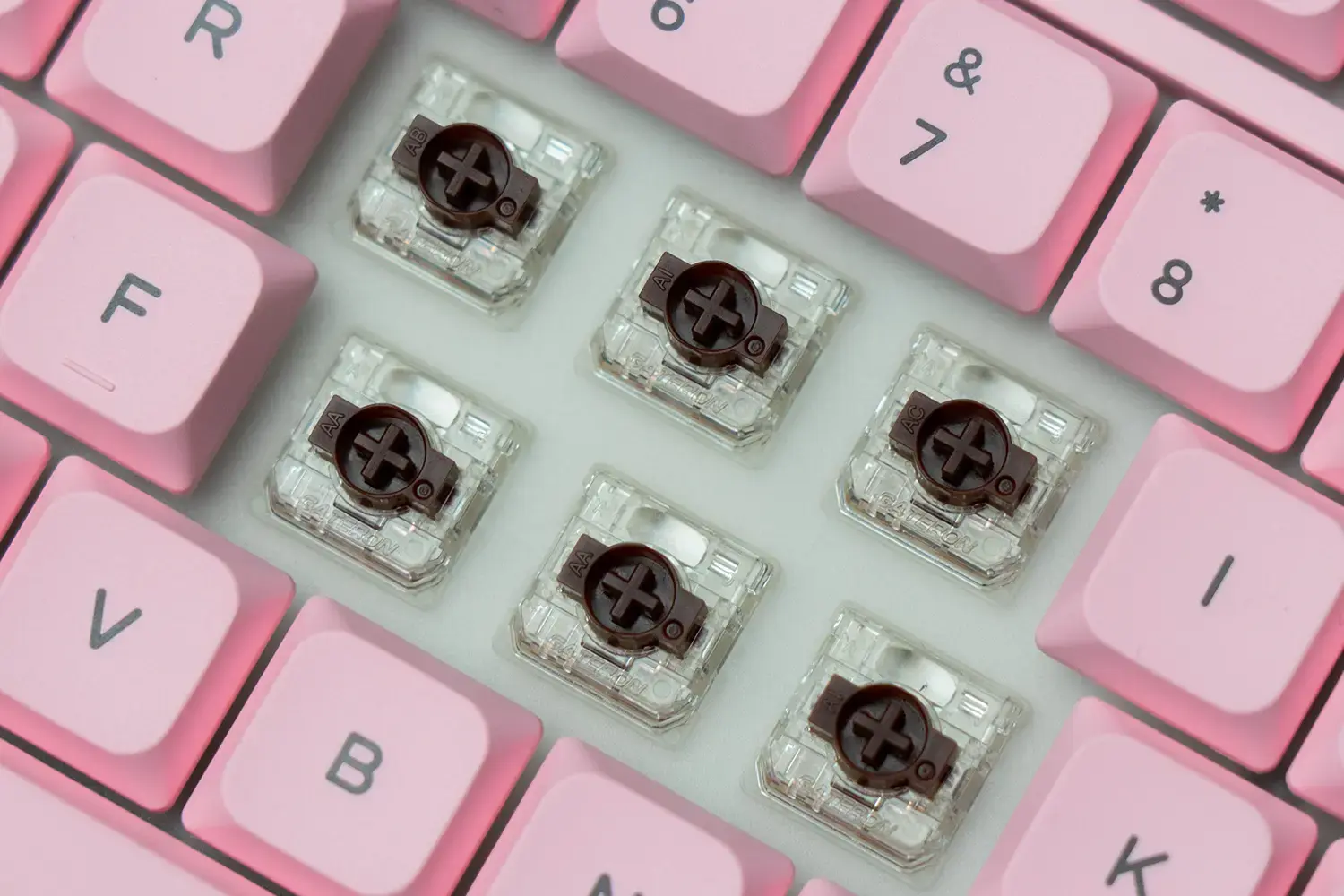
With regard to mechanical compatibility, standard KS-33 2.0 switches are 3-pin, while the KS-33 Low Profile 3.0 Mechanical Switch (featured on Gateron's product page) is 5-pin, which includes locating posts.
However, Gateron has offered 3.0 switches with 3-pin configurations. In this regard, the SKU is of greater importance than the version number.
There are a number of ways a replacement switch can fail integration:
- Incorrect PCB openings: Locating posts can prevent full seatingof the switch if the PCB does not have corresponding holes for switch positioning.
- Socket Misalignment: Switch stems may appear to be mechanically compatible, but the switches will not function properly if they do not meet the hot-swap contacts.
- Plate interference: Different switch housing retention geometries can leave switches poorly secured and/or seated.
- Keycap interference: Thestem geometry of a switch determines travel and keycap fit.
The KS-33 3.0 switches referenced by Gateron are only compatible with selected NuPhy keyboards, which include the Nos75, Kick75, Air75 V3, and Node75.
To ensure a switch is compatible with a board for OEM integration, examine the footprint diagram for the switch and check the assembled switch/PCB/plate and keycap stack-up.
5. What Should OEM Buyers Test Before Switching to 3.0?
We test according to the specifications provided by the customer. Small differences occur during manufacturing due to assembly, and production tests are usually necessary.
Mechanical switches should be tested for their full force-displacement curves. The full displacement of a mechanical switch can vary depending on how the switch is actuated and released. Various off-center loads should also be considered.
Electrical testing should include contact bounce and switching repeatability, as well as intermittent registration. All of these should be considered with respect to the keyboard's debounce algorithm and matrix scan behavior.
Assembly qualification should test the construction of the actual keyboard. This includes switch seating, contact and LED insertion, plate retention and stand-off height, keycap movement and stroke.
Friction and contact instability can be identified by measuring the switch mechanism's full force-displacement curve. This is especially relevant at extremes of the intended use environment, as humidity and temperature can affect switches.
Purchasing decisions should be confirmed as follows:
- Exact KS-33 variant, pin configuration, and revision
- Approved dimensional and force tolerances
- Consistency of sample against accepted limits
- Reliability and lot traceability documentation
Test methods, acceptance levels, and sample size should be established for a particular application, rather than inferred from designation of the keyboard generation.
When Does the 3.0 Upgrade Make Engineering Sense?
For a new keyboard platform, KS-33 3.0 offers revised stroke options and selected lower-force configurations worth evaluating. For an established 2.0 design, changing switches may introduce more mechanical requalification work than the desired typing improvement justifies.
The deciding evidence is the measured behavior of the complete keyboard—not the switch version printed on a specification sheet.
Gateron offers KS-33 configurations for different low-profile keyboard requirements. Explore our KS-33 Low Profile 3.0 Mechanical Switches and confirm the appropriate variant before finalizing your PCB and switch specifications.
FAQs
Q1: What is the main difference between Gateron KS-33 2.0 and 3.0 switches?
Gateron KS-33 3.0 introduces longer maximum total travel in standard Red, Brown, Silver, and Blue variants, revised operating forces for selected switches, and SKU-specific mounting configurations.
Q2: Do Gateron KS-33 3.0 switches have shorter pre-travel?
No. The standard Red and Brown variants retain 1.7±0.4 mm pre-travel, while Silver retains 1.2±0.3 mm. The primary travel change is increased maximum total stroke.
Q3: What is the total travel of Gateron KS-33 3.0 switches?
Red and Brown specify 3.4 mm maximum total travel, while Silver and Blue specify 3.5 mm. The Silent Red variant has a 3.2 mm maximum stroke.
Q4: How does the Gateron KS-33 3.0 Silver differ from 2.0?
KS-33 3.0 Silver reduces nominal operating force from 50 gf to 43 gf and increases maximum total travel from 3.2 mm to 3.5 mm. Pre-travel remains 1.2 mm.
Q5: Are Gateron Low Profile Mechanical Switches 3.0 better for gaming?
Not automatically. The 3.0 Silver offers lighter nominal actuation, but actual gaming response depends on switch characteristics, firmware debounce, keyboard scanning, and input processing.


