A switch that tests well as a silent switch can pick up noticeable noise after it has been installed. Sound changes when a switch is mounted on a rigid plate. Return-stroke noise becomes noticeable when the switch is actuated quickly. Larger stabilized keys introduce rattle when in use.
For a keyboard manufacturer, the challenge is identifying the exact location of noise when designing the best silent linear switches. Sometimes compromises need to be made in order to ensure that consistent switch actuation and key return are not disrupted.
At Gateron, we have taken two approaches to this challenge. First, we have focused on damping structures for quiet operation. Second, we have used a linear mechanism for stem control. Both approaches improve typing quality and feel, but solve different mechanical issues.

1. Which Switch Components Actually Reduce Noise?
Removing the tactile bump on a switch does not automatically make it silent. Conventional linear mechanisms still result in audible impacts at each end of the stem’s travel.
There are three impacts that need to be considered:
- Bottom-out: The stem reaches its lower stop and vibration is transmitted to the switch housing, mounting plate, and PCB.
- Top-out: The spring pushes the stem against its upper stop and an audible impact occurs.
- Sliding friction: Noise may be generated between the stem rails and the guides in the switch housing. This is usually due to off-center loading.
A properly designed silent mechanism addresses the first two sources through compliant damping elements.
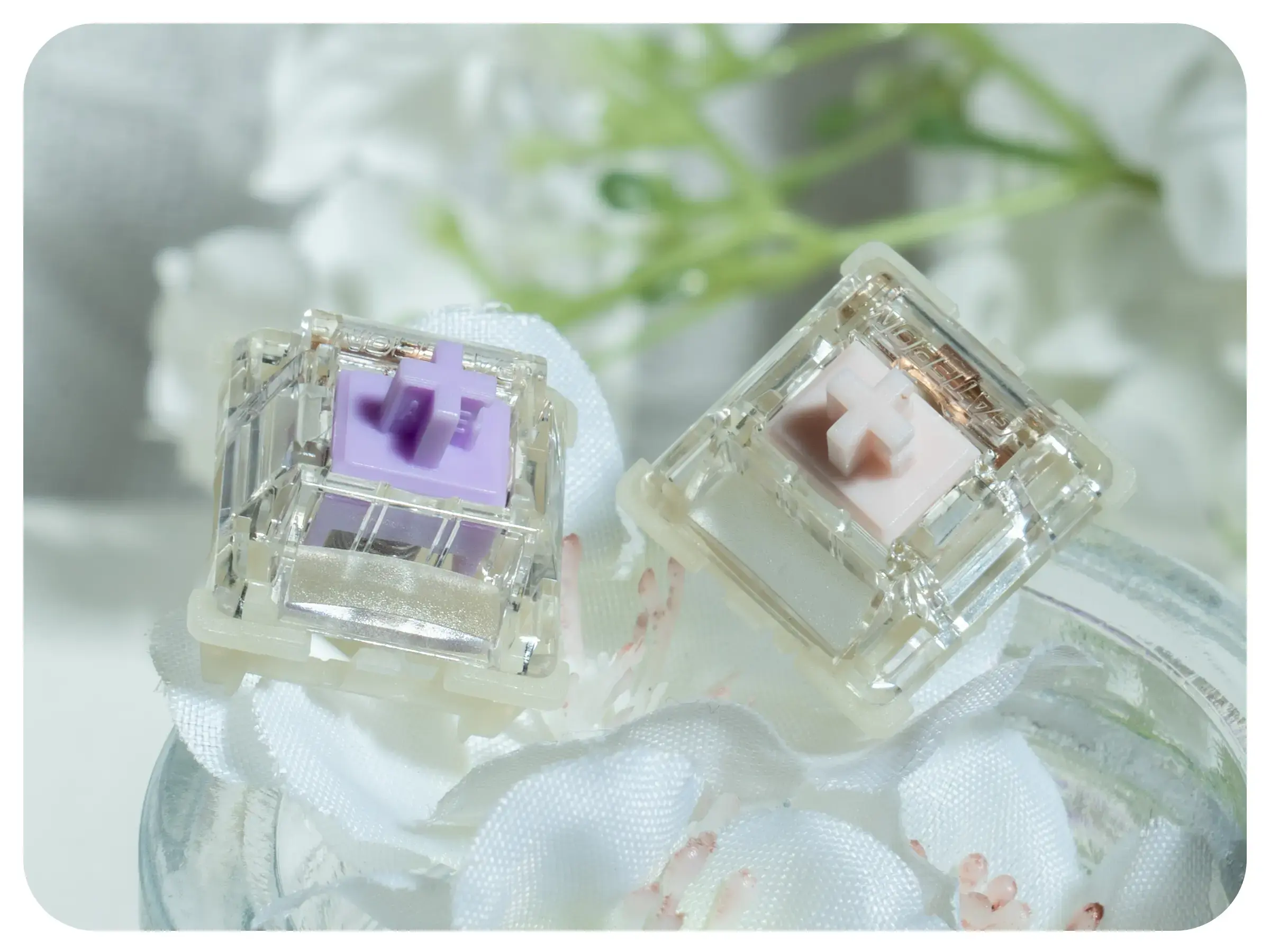
For example, the Gateron KS-9 Silent 3.0 Pink incorporates upgraded damping rings on both sides of the stem. The Zero Degree Fully Silent uses rebound shoulder mute pads and bottom-touch mute pads to control impact at different stroke positions.
The engineering trade-off is straightforward: softer contact reduces hard-stop excitation but changes the mechanical feel near the travel limits.
The bottom-out response may feel less defined if the damping elements are too soft. Without enough damping, the impact remains sharper. Long-term compression set, or material changes, can affect the original response, and repeated-actuation testing may be required.
2. Why Do Similar Operating Forces Produce Different Typing Experiences?
Two switches carrying a nominal 45 gf operating-force specification can feel different during actual use.
Operating force represents one point on the force-displacement curve. It does not fully describe the force required at bottom-out, the restoring force during release, or frictional resistance throughout the stroke.
Three characteristics determine the practical result.
Force Progression and Return
Spring geometry affects force progression. Although a dual-stage spring can provide more control for balancing initial resistance and return force, spring length alone cannot fully dictate the force curve.
In silent switches, springs must also overcome damping resistance, and a less-than-ideal combination of spring-damping elements may result in sluggish return. In addition, excessive friction may result in a "lighter than expected" first stage.
Actuation Position
Pre-travel determines where electrical actuation occurs relative to the mechanical stroke.
A shorter pre-travel may suit applications requiring early activation, but it can also increase unintended inputs when users rest their fingers on the keys. The correct choice depends on the input task rather than speed claims alone.
Consistency Across Switches
Published operating-force tolerances should not be mistaken for evidence of uniform typing feel.
Force-displacement curves from a number of samples should be compared by engineers looking at changes in actuation position, friction and return behavior.
3. How Do Gateron Silent Switches Compare With Dual-Rail Linear Switches?
Gateron's product range provides a useful comparison between mechanical damping and stem-guidance design.
|
Gateron Model
|
Operating Force
|
Total Travel
|
Structural Focus
|
|
KS-9 Silent 3.0 Pink
|
45±15 gf
|
3.8 mm max
|
Upgraded silent rings, factory pre-lubrication
|
|
Smoothie Pink Silent
|
45±15 gf
|
3.8±0.2 mm
|
Full-POM construction, silent rings
|
|
Zero Degree Fully Silent
|
45±15 gf
|
3.6 mm max
|
Double-rail guidance, shoulder and bottom mute pads
|
|
Dual-Rail Lunar Probe
|
45±15 gf
|
3.6 mm max
|
Reinforced stem guidance, crisp bottom-out response
|
The Gateron Dual-Rail Lunar Probe demonstrates why stability and silence must be evaluated independently.
Its reinforced dual-rail structure guides the stem during movement, helping control lateral displacement. The switch also uses a POM stem, PC top housing, nylon bottom housing, factory lubrication, and a 22 mm dual-stage spring.
However, Lunar Probe is not marketed as a silent switch. Its design deliberately produces a clean, crisp bottom-out sound.
Dual-rail guidance can reduce unwanted stem movement, but it does not replace dedicated impact dampers. The Zero Degree Fully Silent combines both approaches for applications requiring guided movement and noise reduction.
4. Do Housing Materials and Factory Lubrication Change Acoustic Performance?
Acoustic performance is influenced by several factors. Friction, stiffness and wear have different effects and do not determine acoustic performance on their own.
POM has good sliding characteristics and is often used in stems. Nylon and polycarbonate differ in several properties, but how they influence acoustics depends on part geometry, contact stiffness and how the parts are assembled.
A fully POM construction could decrease friction. Impact at the travel limits still needs to be dampened.
Lubrication is another variable. Some areas may have no lubricant at all, while other areas may be lubricated too much, resulting in excess drag.
When evaluating production samples, buyers should look at three things:
- Stem movement with different loads
- Lubrication consistency and changes in sliding friction
- Fit of the housing and how the rails make contact with each other after multiple actuations
A really smooth sample does not necessarily indicate consistency in production.
5. How Can Procurement Teams Verify Noise and Reliability?
There is no reliable way to determine which switch is quieter from sound demonstrations alone.
To be able to draw a real comparison, switches must be tested with identical keyboards or keyboards that are as similar as possible in terms of keycaps, stabilizers, mounts and actuation.
Recommended qualification checks are:
- Acoustic Testing: Evaluatethesound pressure level (SPL) of switch actuation and compare frequency-domain data.
- Force-Displacement Testing: Characterize the force curve, actuation position, bottom-outand return behavior of a switch.
- Off-Center Loading: Assess stem tilt, binding and increased friction.
- Repeated Actuation: Asseschanges in acoustic and electrical behavior of the switch and changes in damping feel.
- Assembly: Check pin alignment and the PCB footprint, hot-swap socket compatibility, stabilizer clearance, and RGB LED clearance.
Qualification testing should include samples from multiple production lots. Prior to qualification testing, acceptance criteria should be determined by procurement. Minor deviations in samples after testing should not be the basis for acceptance.
These verification methods are provided for Gateron products; no results from comparative tests involving Gateron switches are claimed.

Which Design Should Buyers Specify?
For noise-sensitive office keyboards, dedicated damped linear switches should be the initial candidates. Gateron's KS-9 Silent 3.0 Pink and Smoothie Pink Silent provide two relevant configurations, while Zero Degree Fully Silent adds guided-stem stability to its damping design.
For keyboards where precise stem guidance and a distinct acoustic response take priority, Lunar Probe represents a different design choice.
Gateron Lunar Probe and Gateron Silent Switch Series: Mechanical Structure Comparison and Sample Selection for Keyboard-Level Qualification.
FAQs
Q1. What are the best Gateron silent linear switches?
Gateron's KS-9 Silent 3.0 Pink, Smoothie Pink Silent, and Zero Degree Fully Silent are suitable candidates. Each uses dedicated damping structures to reduce mechanical impact noise.
Q2. Is the Gateron Dual-Rail Lunar Probe a silent switch?
No. The Lunar Probe is a conventional linear switch designed for stable stem movement and a crisp bottom-out sound. It does not use the dedicated damping structure found in Gateron's silent models.
Q3. How does Gateron reduce noise in silent linear switches?
Gateron uses damping rings or mute pads to cushion stem impacts during bottom-out and return. Factory lubrication also helps reduce sliding friction.
Q4. What is the difference between Gateron KS-9 Silent 3.0 Pink and Smoothie Pink Silent?
Both offer 45±15 gf operating force and factory lubrication. KS-9 Silent 3.0 Pink uses a POM stem with PC and nylon housing components, while Smoothie Pink Silent uses full-POM construction.
Q5. Does Gateron's dual-rail design make switches quieter?
Not necessarily. Dual-rail guidance primarily improves stem stability. The Gateron Zero Degree Fully Silent combines dual-rail guidance with dedicated damping pads for noise reduction.


