An OEM keyboard designer choosing between Gateron G Pro 3.0 Silver and Red faces a familiar trade-off. Both specify a nominal 45 gf operating force, but Silver actuates at 1.2 mm while Red requires 2.0 mm. Does that 0.8 mm difference justify choosing Silver for a gaming keyboard?
The exact answer to your question depends on how quickly the player moves the key, when the switch resets, how reliable the keyboard is at processing repeat inputs and how long the debounce delay is set to.
For buyers sourcing affordable mechanical keyboard switches, shorter travel distance is beneficial only if it provides better input control while eliminating unintentional keystrokes and/or inconsistent operation.
1. Does Shorter Pre-Travel Actually Reduce Gaming Latency?
Pre-travel is the distance the stem moves before its electrical contacts actuate. Total travel is the available stroke from rest to bottom-out. These dimensions affect different parts of the keystroke.
A 1.2 mm pre-travelt requires less finger displacement than a 2.0 mm pre-travel. At an identical stem velocity, the shorter distance would be reached earlier. Actual finger velocity, however, changes throughout the stroke as the player overcomes spring resistance and friction.
Nor does earlier contact closure guarantee proportionally lower keyboard latency.
There are three parts between finger movement and a registered command:
- Mechanical actuation: The stem pushes against spring tension and the contact closes.
- Electrical detection: The keyboard matrix reads thecontact change. Behavior is determined by scanning and debounce.
- Input Reporting: Firmware processes the event and sends it to host.
Of the three processes, firmware processing can be a significant source of delay, which means that Latency improvements are often hardware limited.
For gaming keyboard development, pre-travel and system latency should therefore be measured separately.
2. Gateron G Pro 3.0 Silver vs Red vs Yellow
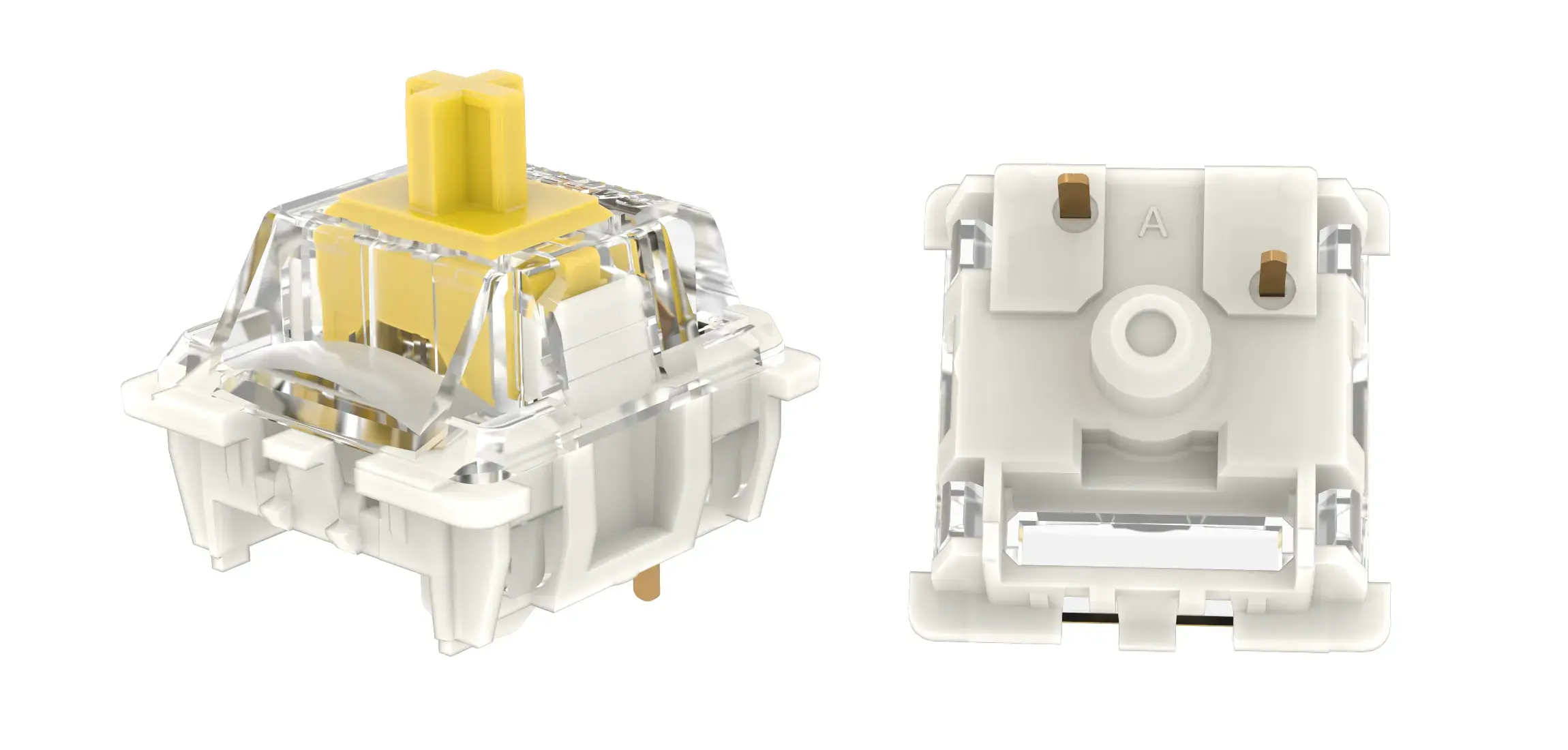
Gateron's G Pro 3.0 series provides three linear switch options that illustrate the interaction between travel and operating force.
|
Specification
|
G Pro 3.0 Silver
|
G Pro 3.0 Red
|
G Pro 3.0 Yellow
|
|
Nominal pre-travel
|
1.2 mm
|
2.0 mm
|
2.0 mm
|
|
Maximum total travel
|
3.4 mm
|
4.0 mm
|
4.0 mm
|
|
Operating force
|
45 ± 15 gf
|
45 ± 15 gf
|
50 ± 15 gf
|
|
Switch type
|
Linear
|
Linear
|
Linear
|
|
Factory lubrication
|
Yes
|
Yes
|
Yes
|
|
Main selection factor
|
Earlier actuation
|
Conventional stroke
|
Higher nominal resistance
|
Silver offers an earlier actuation point without increasing nominal operating force relative to Red. This makes it a candidate for gaming layouts where shallow inputs are preferred.
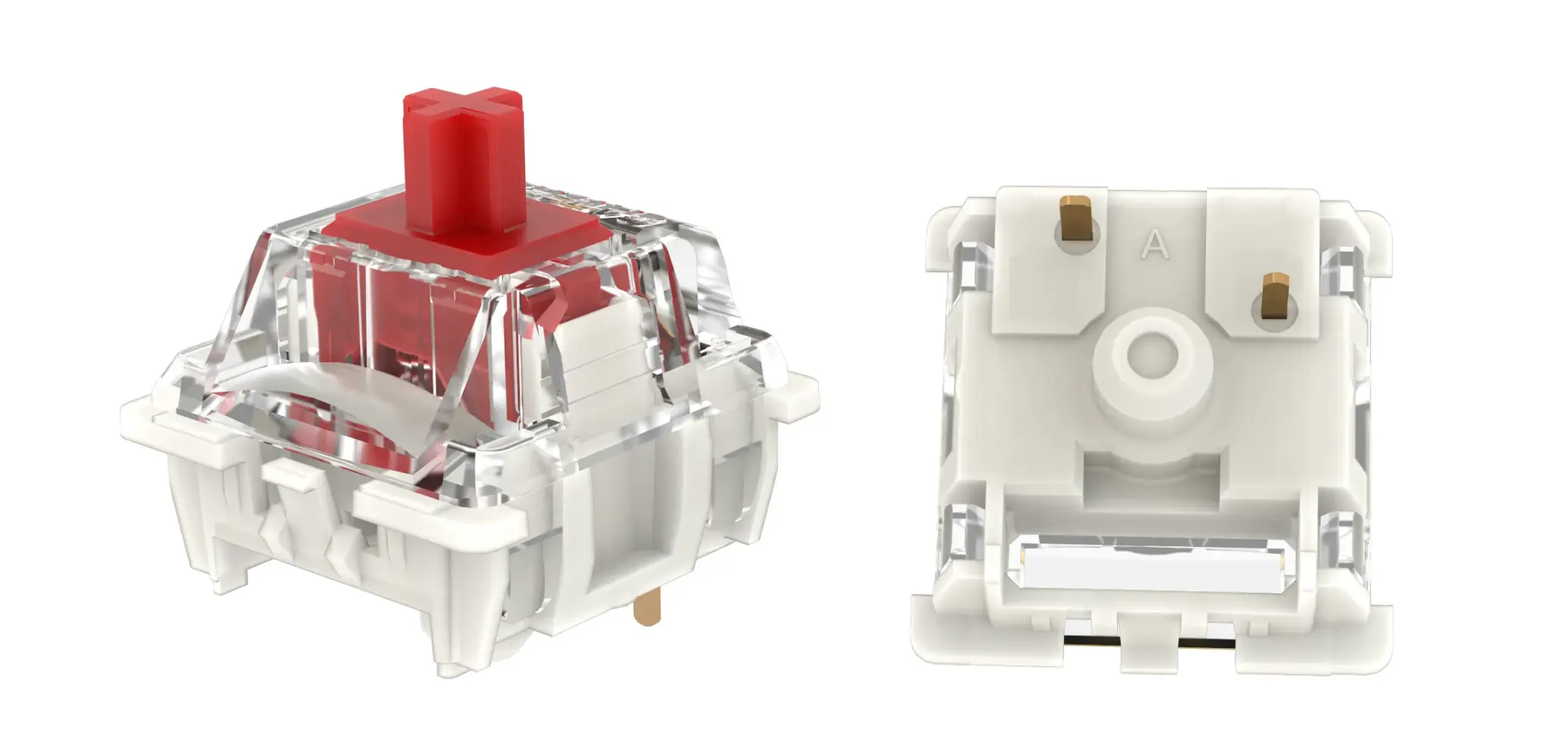
Red preserves a longer stroke, giving users more movement before activation. Yellow retains the same nominal travel as Red but increases operating force.
These differences do not establish which switch produces the fastest response. They establish different mechanical operating conditions.
3. What Problems Can Short-Travel Switches Create?
Unintended Inputs From Resting Finger Pressure
Players of FPS games constantly maintain contact with movement keys. With mechanical switches, the actuation point may be shallow, so a slight movement can register a command.
What leads to errant inputs depends on many factors, including spring preload, force progression, finger pressure, and keycap movement.
Higher operating forces can help some users avoid unwanted activation, but nominal force alone can't describe the entire resistance curve.
Missed Inputs During Rapid Key Repetition
Mechanical switches can exhibit hysteresis, meaning the position at which a switch is reset can be different from the position at which it was actuated.
If a player doesn't reach the reset threshold while releasing the stem, the key may not actuate on the next movement down.
This matters during repeated directional inputs and counter-strafing.
Buyers should request or measure both actuation and reset positions. Pre-travel specifications alone cannot establish repeated-input behavior.
Bottom-Out Feel and Mechanical Stress
Reducing total travel changes where the stem reaches its mechanical stop.
Users who constantly bottom out may experience different impact characteristics, even if the switches have the same nominal operating force.
There are several factors that contribute to the fatigue and durability of a switch. These factors can include the geometry of the stem, spring progression, housing and the overall construction of the switch. A shorter stroke does not necessarily mean greater durability or less fatigue.
4. Why Do Materials, Springs, and Contacts Matter?
Differences in construction can lead to switches behaving unexpectedly even if their travel specifications are the same.
- Springs have a force-displacement curve, meaning the force required throughout the travel distance affects the resistance the stem provides during the stroke. The speed at which the stem returns to its original position also matters.
- Sliding friction: There is resistance created by stem-to-housing contact. The nature of the material pairing, the quality of molded surfaces, how aligned they are, and the lubricant distribution play a role in how consistently and smoothly stems follow a user's fingers. Friction can also lead to stick-slip behavior and variable release feel.
- Electrical contacts : Contacts can bounce , causing multiple transitions to be interpreted as one keystroke . This requires aggressive debounce in firmware to differentiate contact bounce from separate keystrokes.The result can be reporting delays .
Gateron's G Pro 3.0 switches feature connection pins engineered to reduce deformation when inserted or emoved, as well as factory lubrication, to improve switch assembly and mechanical feel.
These features do not address contact bounce, reduce stick-slip friction, improve lubricant distribution, or improve other factors that impact gaming latency. These factors would require testing the keyboard in its intended application.
5. How Should OEM Buyers Test Affordable Gaming Switches?
Evaluating a few switches manually will not expose variations that can occur during high-volume production. That's why we recommend qualifying switch/keyboard assemblies using both GATERON switches and a competitor's switches.
- Force-displacement test: Evaluates operating force, actuation distance, reset position, hysteresis, and the full press and release curve.
- Repeated-input verification: Assesses actuation and release distances via repeated switchingand identifies double releases, reset issues and missed actuations.
- Electrical timing: Decouples mechanical switch actuation and electrical contact operation, differentiating it from firmware debounceand host reporting.
- Environmental Tests: Conduct multiple measurements under various environmental conditions and compare the results with acceptance limits.
- Assembly inspection: Check the PCB footprint, 3- or 5-pin configuration, socket fit, terminal deformation, switch retention.
Use switches from multiple production lots instead of development samples.
When comparing switches, keep the PCB, firmware, keycaps and reporting configuration constant. Behavioral differences in other electrical components of the keyboard can be erroneously attributed to switch differences.
Prior to releasing production orders, procurement teams should agree on acceptance limits for travel variation, electrical reliability and installation defects.
6. When Should Buyers Consider Hall Effect Instead?
Conventional mechanical switches actuate through physical electrical contacts. Their actuation and reset behavior is determined by the switch mechanism.
Hall Effect switches use a moving magnet and a compatible PCB-mounted sensor to detect key position. Supported firmware can establish adjustable actuation thresholds and position-dependent reset behavior, including Rapid Trigger.
That capability is relevant when rapid release and reactivation are more important than retaining conventional mechanical-switch compatibility.
It introduces a different engineering requirement: the magnetic switch, sensor position, PCB layout, and firmware calibration must operate as a matched system.
For cost-sensitive gaming keyboards, G Pro 3.0 Silver remains a candidate when shallow fixed actuation is the objective. Red or Yellow may be more appropriate when a conventional travel profile or greater resistance is preferred.
For OEM projects comparing affordable mechanical keyboard switches, explore the Gateron G Pro 3.0 series or contact Gateron to confirm current specifications and obtain the information needed for sample qualification.
FAQs
Q1: Are shorter-travel mechanical switches better for gaming?
Shorter pre-travel allows earlier actuation with less key movement. However, gaming response also depends on spring resistance, reset behavior, and keyboard firmware.
Q2: Which Gateron G Pro 3.0 switch has the shortest pre-travel?
Gateron G Pro 3.0 Silver has a nominal 1.2 mm pre-travel, compared with 2.0 mm for Red and Yellow.
Q3: What is the difference between Gateron G Pro 3.0 Silver and Red?
Silver has 1.2±0.3 mm pre-travel and 3.4 mm maximum total travel. Red has 2.0±0.6 mm pre-travel and 4.0 mm maximum total travel. Both specify 45 ± 15 gf operating force.
Q4: Is Gateron G Pro 3.0 Yellow suitable for gaming?
Yes. G Pro 3.0 Yellow is a linear switch with 50 ± 15 gf operating force and 2.0 mm pre-travel. It suits users who prefer greater nominal resistance than Red.
Q5: Does shorter switch travel reduce keyboard input latency?
Not necessarily. Shorter pre-travel can reduce the movement required for actuation, but actual input latency also depends on contact debounce, matrix scanning, firmware, and USB reporting.


