In HE Keyboard Switches, performance is often discussed in terms of Rapid Trigger, adjustable actuation, and low input latency. From a switch-manufacturing perspective, however, the electronic side is only half of the system.
A Hall Effect keyboard may detect key position magnetically, but the stem still has to travel through the switch housing thousands or millions of times. How accurately that stem is guided affects keycap stability, friction, sound, and the consistency of each physical stroke.
That is why stem stability has become an important engineering consideration in modern HE Keyboard Switches.
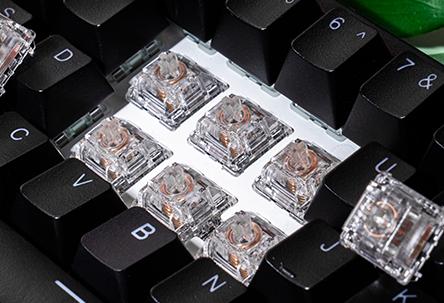
What Stem Stability Actually Means
Inside HE Keyboard Switches, the stem moves vertically while carrying or interacting with a magnet. A small amount of clearance between the stem and housing is necessary; without it, friction could become excessive.
The engineering challenge is controlling that clearance.
Too much lateral freedom can result in:
- Noticeable X/Y-axis stem wobble;
- Greater keycap movement during off-center presses;
- Uneven contact between stem and guide surfaces;
- Changes in friction during the stroke;
- Less consistent mechanical feel from key to key.
Stem stability therefore is not simply about making a switch feel "tight." It is about balancing guidance, clearance, friction, and manufacturing tolerance so the stem can move freely while remaining well controlled.
Why Off-Axis Movement Matters in HE Keyboard Switches
Users rarely press every key perfectly through its centerline. WASD inputs, fast repeated taps, large keycaps, and angled finger movements all introduce lateral forces.
The amount of tilt and shift of a stem is determined by the guide structure of the stem.
Improving the guide structure may:
1. Control Keycaps
A more controlled stem path can help reduce side-to-side movement of keycaps.
2. Improve Friction
Friction is determined by how the stem contacts the housing. Better stem guidance improves uniform contact.
3. Improve Acoustics
Better mechanical design and structure help minimize unexpected and uncontrollable variations of stem behavior.
4. Improve Repeated Keystroke Feel
For gaming-oriented HE Keyboard Switches, repeated presses should feel mechanically consistent even when actuation is configured very shallow.
How Dual-Rail-Inspired Structures Improve Stem Guidance
A conventional switch typically relies on the relationship between the stem geometry and its surrounding housing to maintain vertical movement.
A dual-rail or dual-rail-inspired structure introduces additional guiding geometry to better constrain lateral motion.
|
Design Factor
|
Engineering Purpose
|
User-Level Effect
|
|
Additional guide surfaces
|
Limit X/Y displacement
|
Less stem wobble
|
|
Controlled stem clearance
|
Balance freedom and stability
|
Smoother vertical travel
|
|
Stable housing geometry
|
Maintain alignment under load
|
More consistent key feel
|
|
Controlled contact surfaces
|
Reduce irregular side loading
|
More predictable friction
|
The objective is not to eliminate clearance completely. A switch still requires enough dimensional freedom to account for lubrication, material behavior, and manufacturing tolerances.
For HE Keyboard Switches, the goal is controlled vertical movement without introducing unnecessary binding.
Stem Stability and Hall Effect Accuracy Are Not the Same Thing
This distinction is important.
In HE Keyboard Switches, a magnet moves with the stem while a Hall sensor on the PCB measures changes in magnetic field. The keyboard firmware converts those measurements into position information and determines when a key actuates. GATERON's technical guidance therefore treats the switch, Hall sensor, PCB, and firmware as a complete system rather than isolated components.
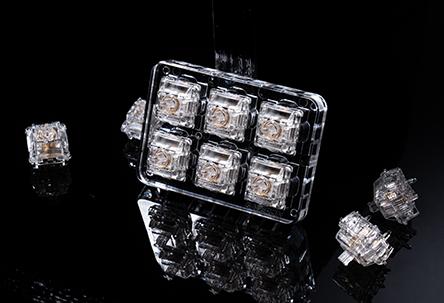
A stable stem can help create predictable physical movement, but it does not automatically mean lower latency or higher sensor resolution.
Actual HE performance also depends on:
- Magnet strength and polarity;
- Magnet-to-sensor distance;
- PCB and Hall sensor geometry;
- Sensor resolution and scan behavior;
- Firmware filtering and calibration;
- Rapid Trigger implementation;
- USB polling architecture.
This is why evaluating HE Keyboard Switches only by stem wobble—or only by actuation distance—does not tell the whole story.
GATERON Magnetic Jade Max HE Switch: An Engineering Example
The GATERON Magnetic Jade Max HE Switch Set shows how mechanical guidance and magnetic-switch design can be developed together.
GATERON describes its stem structure as "similar to the dual-rail structure," designed to reduce stem wobble and improve stability during operation. The switch also combines a PC stem and PC top housing with a PA12 bottom housing.
Magnetic Jade Max Specifications
|
Specification
|
Magnetic Jade Max
|
|
Switch Type
|
Linear magnetic HE switch
|
|
Initial Force
|
36±5gf
|
|
Total Travel
|
3.5±0.1mm
|
|
Pre-Travel
|
Freely adjustable
|
|
Stem
|
PC
|
|
Top Housing
|
PC
|
|
Bottom Housing
|
PA12
|
|
Lubrication
|
Factory pre-lubed
|
|
Rated Lifetime
|
150 million keystrokes
|
These are GATERON's published specifications for the Magnetic Jade Max.
From a manufacturing perspective, several elements work together here.
Material and Guidance Design
PC components provide the stem and upper housing structure, while the PA12 bottom housing forms part of the lower guidance system. The geometry and dimensional relationship between these parts matter just as much as the material names themselves.
Magnetic Consistency
GATERON states that its magnetic stem uses rare-earth permanent magnet materials, with the design focused on magnetic remanence consistency and stability.
For HE Keyboard Switches, magnetic consistency matters because the PCB must interpret a changing magnetic field throughout the stroke.
Adjustable Actuation Is a System Feature
The Magnetic Jade Max supports freely configurable pre-travel through compatible keyboard driver software.
The key point is that the switch provides the physical travel and magnetic signal; the keyboard determines where within that travel the input is registered.
What Should You Evaluate When Choosing HE Keyboard Switches?
A strong HE switch specification should be considered across several dimensions rather than one headline number:
- Mechanical: Stem guidance, wobble, force curve, total travel and lubrication.
- Magnetic: Magnet orientation, flux characteristics and signal consistency.
- Material: Stem/housing pairing, wear behavior and dimensional stability.
- Electronic: Hall sensor design, PCB geometry and controller performance.
- Software: Calibration, adjustable actuation and Rapid Trigger implementation.
- Compatibility: The magnetic switch must match the Hall Effect platform.
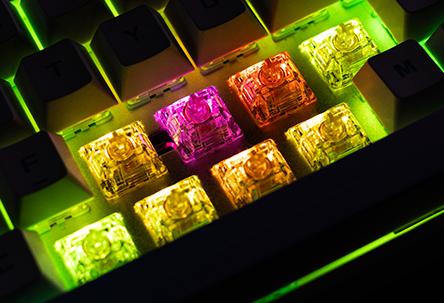
The last point is particularly important. Magnetic switches are not automatically interchangeable simply because they physically fit. GATERON specifies that Magnetic Jade Max is intended for magnetic/Hall Effect keyboards, not conventional mechanical keyboards.
Better HE Keyboard Switches Start With System-Level Engineering
Hall Effect sensing has changed what keyboards can do, but it has not removed the importance of mechanical switch engineering.
For modern HE Keyboard Switches, stem stability, guide geometry, material selection, lubrication, magnet consistency, Hall sensing, firmware, and calibration all influence the final experience.
The GATERON Magnetic Jade Max HE Switch Set illustrates this system-level approach with its dual-rail-inspired structure, 36±5gf initial force, 3.5±0.1mm travel, freely adjustable pre-travel, rare-earth magnetic stem design, and 150-million-keystroke rated lifetime.
For keyboard builders, enthusiasts, or product developers looking to understand how these design decisions come together in a production HE switch, the GATERON Magnetic Jade Max HE Switch Set provides a practical reference point for exploring the structure, materials, and specifications behind current-generation HE Keyboard Switches.
FAQs
Q1. What are HE Keyboard Switches?
HE Keyboard Switches use Hall Effect sensing to detect changes in magnetic field as the stem moves, allowing continuous position detection instead of relying on traditional metal contacts.
Q2. What is the GATERON Magnetic Jade Max HE Switch?
The GATERON Magnetic Jade Max is a linear magnetic switch designed for compatible Hall Effect keyboards, with adjustable pre-travel and a stability-focused stem structure.
Q3. What is the initial force of the GATERON Magnetic Jade Max?
The Magnetic Jade Max has an initial force of 36±5gf.
Q4. What is the total travel distance of the Magnetic Jade Max?
Its rated total travel is 3.5±0.1mm.
Q5. Does the GATERON Magnetic Jade Max have adjustable actuation?
Yes. Its pre-travel can be freely adjusted when used with a compatible Hall Effect keyboard and supported driver or firmware.



