For Hall Effect keyboards, magnetic flux specifications such as 100 GS or 700 GS density are more than numbers on a datasheet. They describe the magnetic field available to the Hall sensor as a switch moves through its travel—and therefore help define the sensing window that the keyboard electronics must interpret.
At GATERON, we treat magnetic performance as part of a complete electromechanical system. With Gateron Keyboard Switches, the magnet, stem geometry, Hall sensor position, PCB structure, mechanical tolerances, and firmware calibration all influence the final result.
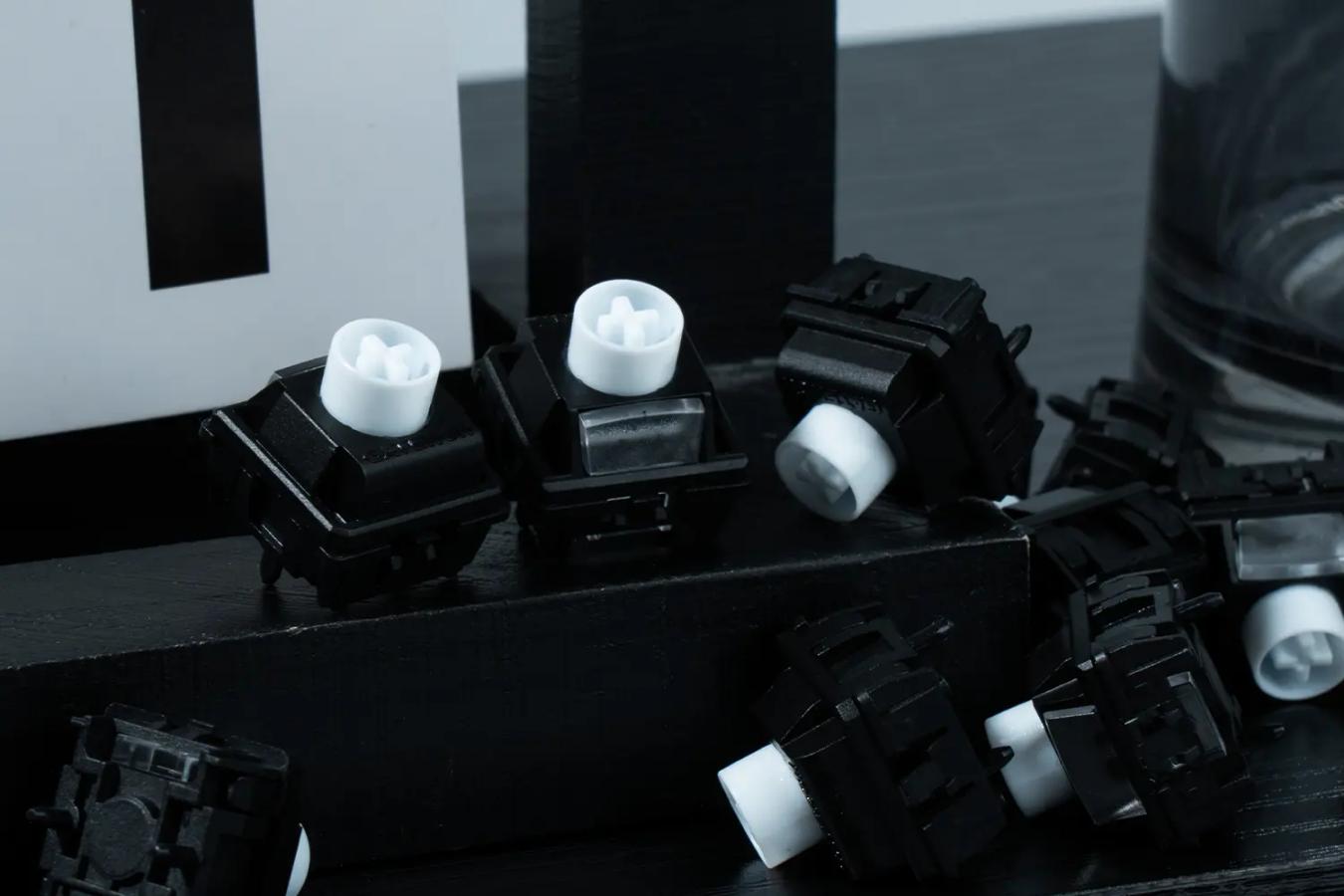
The GATERON Magnetic Black Lotus HE provides a useful example: it is specified at 100±8 GS initially and 700±30 GS at bottom-out on a 1.2 mm PCB.
What Does GS Actually Measure?
Gauss (G, often written as GS in keyboard specifications) is a unit of magnetic flux density, not magnetic flux itself. One gauss equals 10⁻⁴ tesla, meaning:
|
Magnetic Flux Density
|
SI Equivalent
|
|
100 GS
|
10 mT
|
|
300 GS
|
30 mT
|
|
500 GS
|
50 mT
|
|
700 GS
|
70 mT
|
This distinction matters. Magnetic flux density describes the magnetic field at the sensing location; it does not directly indicate spring force, actuation distance, scan rate, or keyboard latency.
How Hall Effect Sensing Works in Gateron Keyboard Switches
A conventional mechanical switch typically relies on a physical electrical contact at a fixed point. A Hall Effect system works differently.
As the key moves:
Stem travel → magnet displacement → magnetic-field change → Hall sensor output → firmware-calculated key position
Hall sensors convert magnetic-field changes into electrical signals that can be used for position sensing. Importantly, magnetic field strength changes with magnet-to-sensor distance, so the useful operating range depends heavily on mechanical geometry.
This is what allows compatible Gateron Keyboard Switches to support functions such as adjustable actuation and Rapid Trigger without relying on one fixed metal-contact point.
What Does 100 GS to 700 GS Mean?
For the Magnetic Black Lotus HE, GATERON publishes the following specifications:
|
Specification
|
Black Lotus HE
|
|
Switch Type
|
Linear Hall Effect
|
|
Initial Force
|
35 gf
|
|
Bottom-out Force
|
45 gf
|
|
Total Travel
|
4.0 mm
|
|
Adjustable Travel
|
0.1–4.0 mm
|
|
Initial Magnetic Flux
|
100±8 GS
|
|
Bottom-out Magnetic Flux
|
700±30 GS
|
|
Test Condition
|
1.2 mm PCB
|
|
Lubrication
|
Pre-lubed
|
The 100±8 GS value represents the field near the switch's initial position. As the stem travels and the magnet approaches the sensing region, the field increases, reaching approximately 700±30 GS at bottom-out.
The engineering value is not simply "700 is higher than 100." What matters is the measurable field change across the usable travel range. That signal must be sufficiently stable and repeatable for firmware to map magnetic readings to physical key position.
Does Higher GS Mean a Faster Keyboard?
Not necessarily.
Maximum magnetic flux density is not a direct speed rating. A keyboard's response depends on the complete signal chain:
- Magnet and Hall sensor geometry;
- Sensor sensitivity and measurement range;
- Mechanical travel consistency;
- Firmware calibration and filtering;
- Actuation and reset configuration;
- USB polling and downstream processing.
For this reason, comparing Gateron Keyboard Switches by maximum GS alone misses much of the engineering that determines real-world behavior.
A well-controlled 100–700 GS sensing window can be more useful than a larger headline figure if the overall system produces cleaner, more repeatable position data.
Why PCB Geometry and Calibration Matter
Magnetic switches should never be evaluated independently of the keyboard platform.
Changing the distance between the magnet and Hall sensor changes the measured field. PCB thickness, sensor placement, magnet orientation, and air gap therefore influence the signal available throughout the stroke. TI likewise notes that Hall-sensing resolution depends on keeping the required movement range within a useful magnetic-field-change region.
This is why GATERON specifies 100±8 GS and 700±30 GS under a 1.2 mm PCB condition rather than presenting the values without a measurement reference.
Firmware must then calibrate that physical signal into usable positions. A 0.5 mm actuation setting, for example, is a software interpretation of the sensor signal—not a magnetic property of the switch itself.

Mechanical Precision Still Matters in a Contactless Switch
Hall Effect sensing removes the traditional electrical contact, but it does not remove mechanical tolerances.
For Gateron Keyboard Switches, several physical variables can affect repeatability:
- Stem alignment and lateral movement;
- Magnet position and orientation;
- Assembly and lubrication consistency.
The Black Lotus HE addresses stem stability with a precision-machined cylindrical stem and 360° support structure. GATERON designed this geometry to reduce the lateral wobble associated with conventional MX-style stem guidance and maintain more vertical travel when the key is pressed from different positions.
From a Hall Effect engineering perspective, controlled stem motion is relevant because the magnet's path relative to the sensor should remain as repeatable as possible.
Why the ± Values Are Important
The tolerance values in 100±8 GS and 700±30 GS deserve attention.
Real manufactured components do not produce one mathematically identical value across every switch. Specified tolerances define the expected operating spread around the nominal measurement.
For Hall Effect keyboards, the target is therefore not merely a high magnetic number. It is consistent, calibratable behavior across a production batch.
This is where manufacturing control becomes part of electrical performance. GATERON maintains in-house R&D, mold manufacturing, and integrated production processes, allowing mechanical design and switch manufacturing to be managed as one system rather than as isolated components. GATERON also identifies ISO 9001 and IATF 16949 among its manufacturing quality frameworks.
What Should You Evaluate Beyond Magnetic Flux Density?
When selecting Gateron Keyboard Switches for a Hall Effect platform, consider magnetic specifications together with:
|
Parameter
|
Why It Matters
|
|
Magnetic flux density range
|
Defines the available sensing signal
|
|
PCB/sensor geometry
|
Changes measured field strength
|
|
Travel
|
Defines physical movement range
|
|
Actuation adjustment
|
Defines where input is registered
|
|
Spring force
|
Determines physical key feel
|
|
Stem stability
|
Supports repeatable magnet movement
|
|
Firmware calibration
|
Establishes the mapping between sensor data and position
|
|
Manufacturing tolerance
|
Influences switch-to-switch consistency
|
Magnetic Flux Density Is a System Parameter, Not a Speed Score
The most useful way to understand Gateron Keyboard Switches is to look beyond a single GS figure.
In the Magnetic Black Lotus HE, the combination of 100±8 GS to 700±30 GS magnetic flux density, 35 gf initial force, 45 gf bottom-out force, 4.0 mm total travel, 0.1–4.0 mm adjustment, pre-lubrication, and cylindrical stem guidance illustrates how magnetic sensing and mechanical design work together.

For engineers, keyboard enthusiasts, or users researching Hall Effect technology, these specifications provide a practical way to understand what magnetic switch performance actually involves.
To examine the design and full specifications in more detail, explore the GATERON Magnetic Black Lotus HE Switch Set on the official GATERON product page.
FAQs
Q1. What does 100–700 GS mean in Gateron Keyboard Switches?
It describes the magnetic flux density measured across the switch travel. For the GATERON Magnetic Black Lotus HE, the specified range is 100±8 GS initially to 700±30 GS at bottom-out on a 1.2 mm PCB.
Q2. Does a higher GS rating make Gateron Keyboard Switches faster?
No. GS measures magnetic flux density, not keyboard latency.. Response also depends on the Hall sensor, firmware, scan rate, actuation settings, and USB polling.
Q3. What are the initial and bottom-out forces of the GATERON Black Lotus HE?
The Black Lotus HE has an initial force of 35 gf and a bottom-out force of 45 gf.
Q4. What is the total travel of the Black Lotus HE?
The GATERON Magnetic Black Lotus HE has 4.0 mm total travel with freely adjustable pre-travel on compatible Hall Effect platforms.
Q5. Why does GATERON specify PCB thickness for magnetic flux density?
Magnet-to-sensor distance affects the magnetic field measured by a Hall sensor. GATERON therefore specifies the Black Lotus HE magnetic values under a 1.2 mm PCB test condition.



