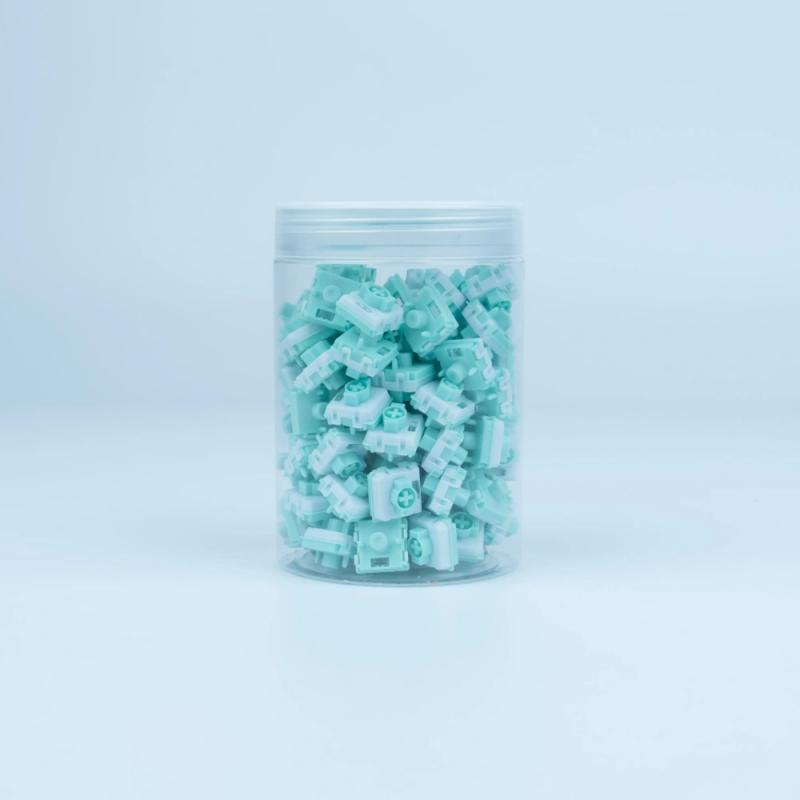
Low-profile keyboards and magnetic sensing are developing toward the same goal: more performance from less physical space. Hall Effect Keyboard Switches make that possible by replacing a fixed electrical contact point with continuous magnetic position sensing.
At GATERON, we see low-profile Hall Effect design as more than making a conventional magnetic switch shorter. Reducing switch height changes the relationship between stem travel, magnet position, Hall sensor distance, spring behavior, structural stability, and firmware calibration. A reliable low-profile HE switch must control all of these variables as one system.
How Hall Effect Keyboard Switches Actually Detect a Keystroke
A conventional mechanical switch registers input when metal contacts close. Hall Effect Keyboard Switches work differently.
A permanent magnet moves with the switch stem. A Hall sensor mounted on the PCB measures the changing magnetic field as the key travels. The keyboard controller interprets that changing signal as position data and determines where actuation and reset should occur. This contactless sensing architecture enables adjustable actuation and features such as Rapid Trigger on compatible keyboards.
The signal chain can be simplified as:
Stem movement → Magnet displacement → Magnetic-field change → Hall sensor output → Controller signal processing → Key actuation
That distinction matters. The switch itself does not independently determine a software-adjustable actuation point. The switch, magnet, Hall sensor, PCB and firmware operate together.
Why Low-Profile Hall Effect Keyboard Switches Are Harder to Engineer
Shortening the mechanism reduces the available engineering envelope. Several parameters become more sensitive.
1. Magnet-to-Sensor Geometry
A Hall sensor does not simply detect whether a magnet is present. It measures changes in magnetic field across the key travel.
The resulting sensor readings and their interpretation can be affected by:
- Magnet strength, geometry and polarity;
- Vertical distance between the magnet and sensor;
- PCB thickness and Hall sensor placement;
- Firmware calibration and sensing range.
This is why two Hall Effect Keyboard Switches that physically fit the same keyboard are not automatically electrically compatible. GATERON specifically recommends considering PCB thickness, sensor position, magnet characteristics, polarity and firmware calibration when evaluating magnetic-switch compatibility.
2. Travel vs. Control
Low-profile construction naturally reduces available movement. However, shortening travel should not create unstable stem motion or an abrupt bottom-out.
The engineering objective is therefore not simply “shorter travel,” but controlled travel within a smaller vertical package.
3. Stem Stability
With less space available, housing guidance and stem geometry become particularly important. Excessive lateral movement can affect key feel, acoustics and the consistency of magnet travel relative to the sensor.
Low-Profile HE vs. Other Switch Architectures
|
Design Factor
|
Low-Profile Hall Effect
|
Full-Height Hall Effect
|
Low-Profile Mechanical
|
|
Input detection
|
Magnetic position sensing
|
Magnetic position sensing
|
Electrical contacts
|
|
Physical profile
|
Low
|
Standard/full height
|
Low
|
|
Adjustable actuation
|
Platform-dependent
|
Platform-dependent
|
Generally fixed
|
|
Contact debounce
|
Not required for magnetic sensing
|
Not required for magnetic sensing
|
Usually required
|
|
Sensor/firmware dependency
|
High
|
High
|
Low
|
|
Main engineering priority
|
Compactness + sensing accuracy
|
Travel + sensing flexibility
|
Compact mechanical actuation
|
The table also explains why Hall Effect Keyboard Switches should be evaluated as components of an electronic sensing platform, not only by traditional switch specifications such as force and travel.
GATERON Full POM Low Profile Magnetic Jade Pro HE: An Engineering Example
The GATERON Full POM Low Profile Magnetic Jade Pro HE Switch shows how these requirements can be combined in a production low-profile magnetic switch.
Its specifications include:
|
Specification
|
GATERON Low Profile Magnetic Jade Pro HE
|
|
Switch type
|
Linear
|
|
Initial force
|
40 ± 10 gf
|
|
Pre-travel
|
Freely adjustable
|
|
Total travel
|
3.5 ± 0.2 mm
|
|
Spring
|
18 mm
|
|
Material
|
Full POM
|
|
Lubrication
|
Factory pre-lubed
|
|
Rated lifespan
|
100 million keystrokes
|
These numbers need context.
A 3.5 ± 0.2 mm total travel preserves meaningful physical movement while supporting a lower-profile architecture. The 18 mm spring is designed to provide controlled rebound, while software-defined pre-travel allows a compatible Hall Effect keyboard to determine where within that movement the input is registered.
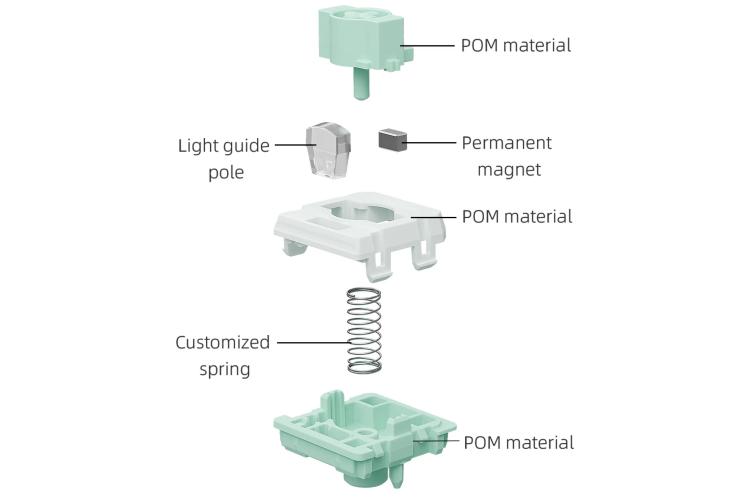
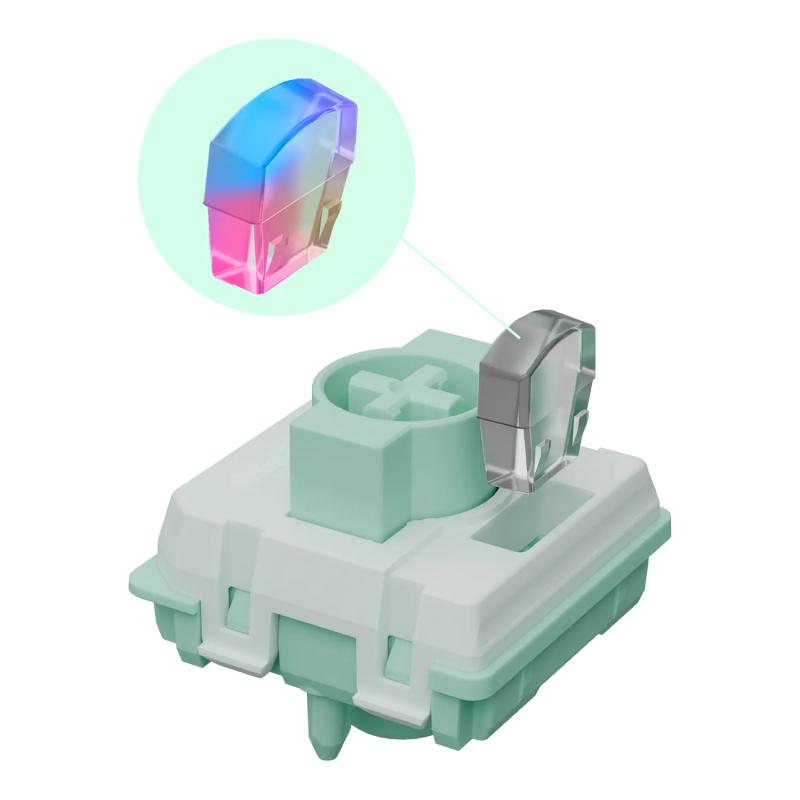
The switch also uses a square permanent magnet and a stability-oriented structure similar to a dual-rail design. According to GATERON, this construction is intended to reduce stem wobble and improve movement stability.
Why Full POM Matters in Low-Profile Hall Effect Keyboard Switches
Magnetic sensing eliminates electrical contact wear at the actuation point, but the switch remains a mechanical system. The stem still slides against guiding surfaces, and the spring still cycles continuously.
Material selection therefore matters.
GATERON uses full POM construction in the Low Profile Magnetic Jade Pro HE because POM offers useful self-lubricating and wear-resistant characteristics. Factory lubrication further reduces sliding friction and mechanical noise.
For Hall Effect Keyboard Switches, smoother mechanical travel has an additional engineering benefit: predictable stem movement helps maintain a more repeatable relationship between magnet position and sensor reading.
Manufacturing Precision Is Part of HE Performance
Hall Effect technology shifts part of switch performance from a discrete contact event to a continuous mechanical-to-magnetic relationship.
That makes dimensional consistency especially important.
At GATERON, independent R&D, in-house mold making and end-to-end manufacturing allow us to manage the relationship between housing dimensions, stem geometry, materials and magnetic components throughout production. GATERON also states that it applies comprehensive quality management and 100% inspection through its production processes, with certifications including ISO 9001 and IATF 16949.
For low-profile Hall Effect Keyboard Switches, this type of process control matters because relatively small dimensional changes can alter feel, magnet travel or sensor geometry.
Are Low-Profile Hall Effect Switches Always Better?
No. Low profile is an engineering choice, not a universal upgrade.
Full-height switches remain relevant for users who prefer longer travel or a different acoustic and mechanical feel. Hall Effect systems also require compatible PCBs, sensors and firmware. Very shallow actuation settings may improve responsiveness for certain applications but can also increase unintended inputs.
The right question is therefore not whether Hall Effect Keyboard Switches are universally better, but whether their form factor, magnetic characteristics and host keyboard platform are engineered to work together.
Where Low-Profile Hall Effect Technology Is Heading
The next stage of Hall Effect Keyboard Switches is not simply about making actuation faster. It is about improving the entire relationship between mechanics, magnetic sensing, materials and software while moving into thinner keyboard architectures.
The GATERON Full POM Low Profile Magnetic Jade Pro HE is one example of that direction: 3.5 ± 0.2 mm travel, freely adjustable pre-travel, full-POM construction, an 18 mm spring and a stability-focused magnetic structure packaged around Hall Effect sensing.
For keyboard designers, enthusiasts and brands evaluating low-profile magnetic technology, GATERON continues to develop Hall Effect Keyboard Switches around both switch-level engineering and manufacturing control.
Explore GATERON's latest magnetic switch technologies and technical specifications at GATERON.com to see how Hall Effect designs can fit into your next keyboard platform.
FAQs
Q1. What are GATERON Hall Effect Keyboard Switches?
GATERON Hall Effect Keyboard Switches use a permanent magnet and a PCB-mounted Hall sensor to detect key movement without conventional electrical contact at the actuation point.
Q2. How do GATERON Hall Effect Keyboard Switches work?
As the stem moves, the magnet changes position relative to the Hall sensor. The keyboard measures changes in the magnetic field and converts them into key-position data.
Q3. Are GATERON Hall Effect Keyboard Switches compatible with every HE keyboard?
No. Physical fit alone does not guarantee compatibility. Sensor position, magnet polarity, magnetic characteristics, PCB design, and firmware calibration can affect operation.
Q4. What is the GATERON Full POM Low Profile Magnetic Jade Pro HE?
It is a low-profile linear Hall Effect switch using full-POM construction, a square permanent magnet, an 18 mm spring, and a stability-focused stem structure.
Q5. What is the total travel of the GATERON Full POM Low Profile Magnetic Jade Pro HE?
The Full POM Low Profile Magnetic Jade Pro HE has a specified total travel of 3.5 ± 0.2 mm.



