The definition of Gaming Keyboard Switches is changing.
For years, switch performance was discussed mainly in terms of actuation force, travel distance, and linear or tactile feel. In 2026, those mechanical parameters still matter, but high-performance Gaming Keyboard Switches are increasingly designed as part of a sensing system that includes magnets, Hall sensors, PCB geometry, firmware, and software-defined actuation.
From our perspective at GATERON, seven technologies are driving that shift.
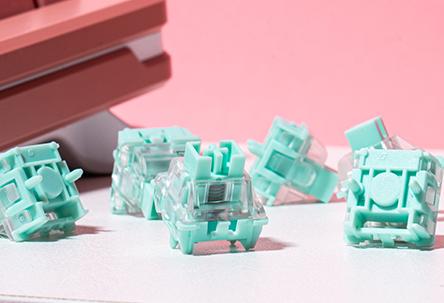
1. Hall Effect Sensing Technology Advances Input Switching
In mechanical switches, input is registered when electrical contacts close. Hall Effect Gaming Keyboard Switches use a Hall Effect Sensor, which is positioned on a PCB and measures magnetic field strength. In the process, a magnet mounted on the switch stem moves to a different position.
This makes key position measurable across the stroke rather than only at one physical contact point. That positional data creates the technical foundation for adjustable actuation, Rapid Trigger, and other software-defined behaviors.
The important distinction is that the switch does not work alone. Signal quality and input behavior depend on the relationship between:
- Magnet strength and polarity;
- Distance between magnet and Hall sensor;
- PCB thickness and sensor placement;
- Firmware calibration and filtering;
- Actuation and reset algorithms.
That system-level relationship is becoming central to modern Gaming Keyboard Switches.
2. Adjustable Actuation Separates Physical Travel From Trigger Distance
Actuation distance no longer needs to be fixed by the switch's electrical contact geometry
With Hall Effect Gaming Keyboard Switches, compatible keyboard software can define where within the key travel an input is registered. A shallow trigger may suit movement keys in FPS games, while a deeper setting can make accidental inputs less likely during typing or on ability keys.
This also means shorter is not automatically better. Spring force determines what the finger feels; software actuation determines when the keyboard responds. They are different parameters and should be tuned independently.
On the GATERON Magnetic Jade Gaming HE, pre-travel is specified as freely configurable when used with a compatible Hall Effect platform.
3. Rapid Trigger Changes How Reset Is Calculated
Conventional switches generally rely on fixed actuation and reset positions. Rapid Trigger uses continuous position sensing to make reset behavior dynamic.
When the key begins moving upward, compatible firmware can recognize that movement without waiting for the switch to cross a traditional fixed reset point. This is particularly relevant to repeated directional inputs and rapid press-release sequences.
For Gaming Keyboard Switches, however, Rapid Trigger should be understood as a system feature:
Switch movement → magnetic signal → Hall sensor → PCB processing → firmware logic → USB output
Changing only the switch cannot compensate for weak calibration or poorly implemented firmware.
4. Low Latency Is an Input-Pipeline Problem
Polling rate is often treated as a shorthand for gaming performance, but an 8,000Hz USB polling specification does not describe total input latency.
The complete path includes sensing, matrix or sensor scanning, controller processing, firmware, USB transmission, and host-side processing. For this reason, we evaluate high-performance Gaming Keyboard Switches in the context of the entire keyboard platform rather than claiming that one switch specification alone determines responsiveness.
Hall Effect technology is valuable because it provides richer positional data—but how quickly and accurately that data becomes an input depends on the electronics around it.
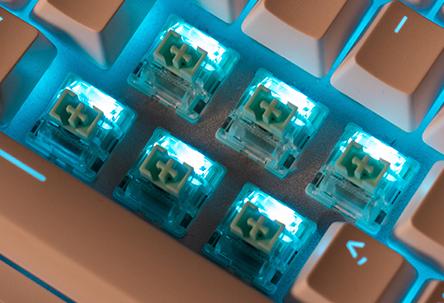
5. Magnetic Flux Density Is Becoming a Real Engineering Specification
For mechanical switches, buyers commonly compare force and travel. For magnetic Gaming Keyboard Switches, magnetic flux density should also be part of the specification.
The GATERON Magnetic Jade Gaming HE provides defined magnetic values measured with a 1.2 mm PCB reference:
|
Specification
|
GATERON Magnetic Jade Gaming HE
|
Engineering Relevance
|
|
Initial force
|
36±5gf
|
Determines initial key feel
|
|
Total travel
|
3.5±0.1mm
|
Defines physical movement range
|
|
Initial magnetic flux
|
120±8Gs
|
Magnetic signal near initial position
|
|
Bottom-out magnetic flux
|
700±30Gs
|
Magnetic signal near full travel
|
|
Pre-travel
|
Freely setting
|
Enables configurable actuation
|
|
Lifetime
|
100M+ keystrokes
|
Rated durability target
|
These tolerances matter because two switches that physically fit the same socket can still produce different magnetic behavior at the sensor.
At GATERON, magnet development is also integrated into our manufacturing process. Our magnet factory combines R&D and production and uses rare-earth permanent magnet materials, with magnetic remanence consistency as a design consideration.
6. Mechanical Stability Still Matters in Magnetic Gaming Keyboard Switches
Contactless sensing does not eliminate mechanical engineering.
The stem still moves inside a housing. Spring behavior, stem guidance, lubrication, dimensional tolerance, and bottom-out structure still affect feel and repeatability.
For the Magnetic Jade Gaming HE, we use a Wall Stem design to improve stem guidance and stability. The switch is linear, factory pre-lubed, rated for more than 100 million keystrokes, and uses a 3.5±0.1mm total travel.
The design also incorporates an arc-shaped light-guide diffuser to increase the light-transmission area and soften RGB diffusion—another reminder that Gaming Keyboard Switches must balance sensing performance with mechanical, acoustic, and lighting requirements.
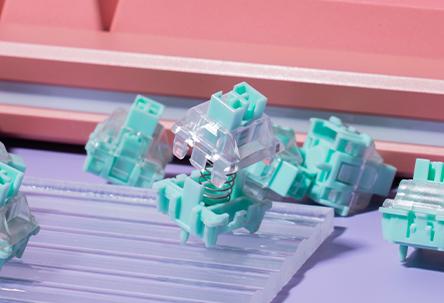
7. Software Is Becoming Part of Switch Design
The next generation of Gaming Keyboard Switches is increasingly defined by what the keyboard can do with positional data.
Depending on the platform, that can include adjustable per-key actuation, Rapid Trigger sensitivity, multiple profiles, and position-dependent commands.
This changes the design question from “Where does this switch actuate?” to “How precisely can the system interpret and configure this switch throughout its travel?”
What Should You Check Before Choosing Gaming Keyboard Switches?
For Hall Effect Gaming Keyboard Switches, we recommend looking beyond one headline specification. Check sensing technology, magnetic flux density, polarity, PCB design, actuation range, Rapid Trigger implementation, force, travel, structural stability, calibration, firmware, and long-term compatibility.
Compatibility deserves particular attention. The GATERON Magnetic Jade Gaming HE uses a downward-facing N-pole orientation and is intended for compatible magnetic/Hall Effect keyboards—not standard mechanical PCBs.
The Future of Gaming Keyboard Switches Is System-Level
The biggest change in Gaming Keyboard Switches is not one individual feature. It is the transition from a fixed mechanical trigger to a configurable electromechanical input system.
Hall Effect sensing, adjustable actuation, Rapid Trigger, controlled magnetic flux density, mechanical stability, and firmware calibration now need to work together.
The GATERON Magnetic Jade Gaming HE reflects that approach with 36±5gf initial force, 3.5±0.1mm travel, freely configurable pre-travel, 120±8Gs initial magnetic flux density, 700±30Gs bottom-out flux density, Wall Stem construction, factory lubrication, and a 100-million-plus keystroke rating.
For builders and keyboard brands evaluating the next generation of Gaming Keyboard Switches, explore the GATERON Magnetic Jade Gaming HE Switch specifications and compatibility to see how these engineering principles are implemented in a production Hall Effect switch.
FAQs
Q1. What are GATERON Hall Effect Gaming Keyboard Switches?
GATERON Hall Effect switches use a magnet and Hall sensor to detect key position without relying on traditional electrical contacts. This enables adjustable actuation and position-based input features.
Q2. What is the GATERON Magnetic Jade Gaming HE Switch?
It is a linear Hall Effect gaming switch designed for compatible magnetic keyboards, featuring adjustable pre-travel, controlled magnetic flux density, Wall Stem construction, and factory lubrication.
Q3. What is the initial force of the GATERON Magnetic Jade Gaming HE?
The Magnetic Jade Gaming HE has an initial force of 36±5gf, providing a relatively light linear key feel.
Q4. What is the total travel of the Magnetic Jade Gaming HE?
The switch has a total travel of 3.5±0.1mm.
Q5. Can the actuation point of the GATERON Magnetic Jade Gaming HE be adjusted?
Yes. The Magnetic Jade Gaming HE supports freely configurable pre-travel when paired with a compatible Hall Effect keyboard and software.



