One of the great benefits of Magnetic Mechanical Switches is the longevity. For example, a switch is said to have a lifespan of 100 million keystrokes. What does that mean? For the average person, who types at about 60 WPM, 100 million keystrokes means 15 to 20 years of daily typing. For competitive gamers, this may be the first keyboard they buy considering the lifecycle of hardware updates, new game titles, and maybe even the duration of their gaming career.
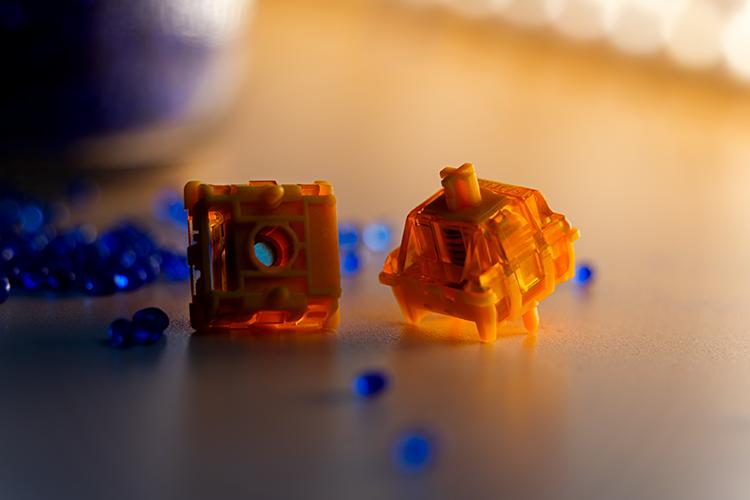
But here is the real question: How does a tiny switch achieve a lifespan that rivals industrial machinery?
The answer lies not in stronger materials or thicker metal—but in the elimination of contact itself.
The Hidden Failure Point of Traditional Mechanical Switches
To understand why 100 million keystrokes is remarkable, you first need to understand why traditional switches fail.
A conventional mechanical switch uses a moving metal contact leaf that slides into contact with a fixed terminal when a key is pressed, and separates when released. This repeated sliding contact—known as contact wear—is the primary source of degradation.
This is what occurs throughout the years:
- Oxidation: Metal contacts react with oxygen which create a non-conductive layer that diminishes signal quality.
- Mechanical fatigue: Collisions cause micro cavities in metal leaves which change its fatigue.
- Debris accumulation: Particles that were worn off contacts interfere with the operation of the switch.
- Actuation becomes inconsistent: It could cause double clicking and/or missing keystrokes.
This is why traditional mechanical switches are actually considered consumables. Their endpoints is a sooner than expected.
The Hall Effect Revolution: Switching Without Touching
Magnetic mechanical switches operate on the Hall effect.
Here is how it works:
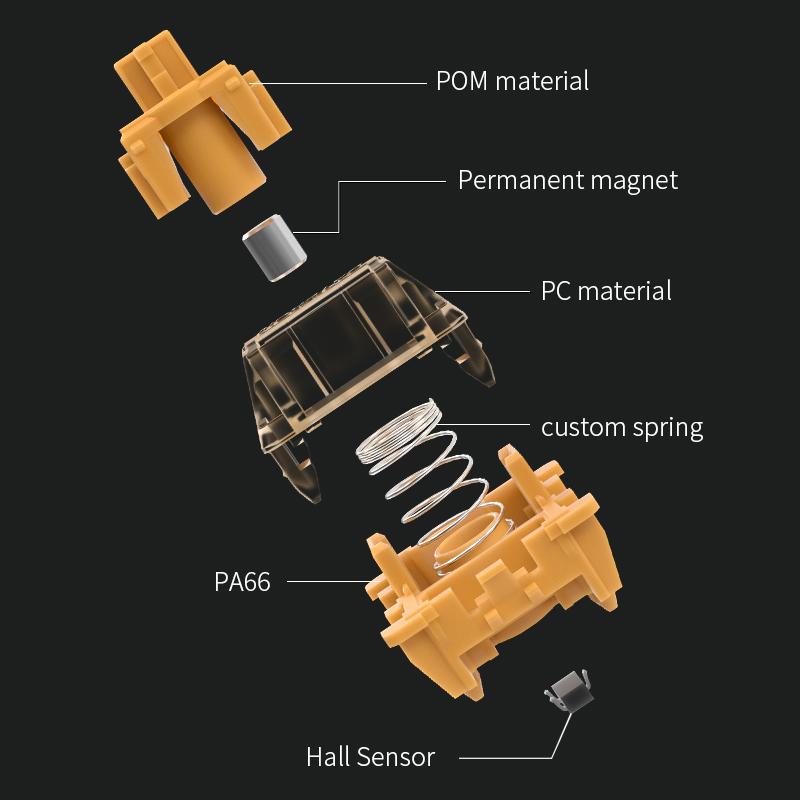
- A permanent magnet is embedded in the switch stem.
- A Hall sensor is located nearby on a printed circuit board.
- Keeping the key down pulls the magnet closer to the sensor.
- The sensor picks up the change and records the keystroke.
But the key difference? There is no physical contact. The switch never needs to "touch" anything to register a press. The stem moves, the magnetic field changes, and the sensor detects it—all without a single point of mechanical friction or electrical arcing.
This is the foundation of the 100 million keystroke lifespan.
Why "No Contact" Means "No Wear"
The durability advantage of magnetic switches is not incremental—it is structural.
|
Factor
|
Traditional Mechanical Switch
|
Magnetic Mechanical Switch
|
|
Actuation mechanism
|
Physical metal-to-metal contact
|
Magnetic field detection
|
|
Primary wear point
|
Contact leaf oxidation and fatigue
|
None (contactless operation)
|
|
Debounce delay
|
5–8ms required to prevent false signals
|
Zero debounce needed
|
|
Lifespan consistency
|
Degrades over time
|
Consistent from first to last press
|
|
Typical rated lifespan
|
50–100 million keystrokes
|
100–150 million keystrokes
|
✅ The key takeaway: The number of switching cycles does not affect the sensor service life. In a magnetic switch, the Hall sensor and the magnet never touch. There's nothing that can oxidize, fatigue, or wear down with use.
GATERON KS-20 Magnetic Orange HE: Engineering for Eternity
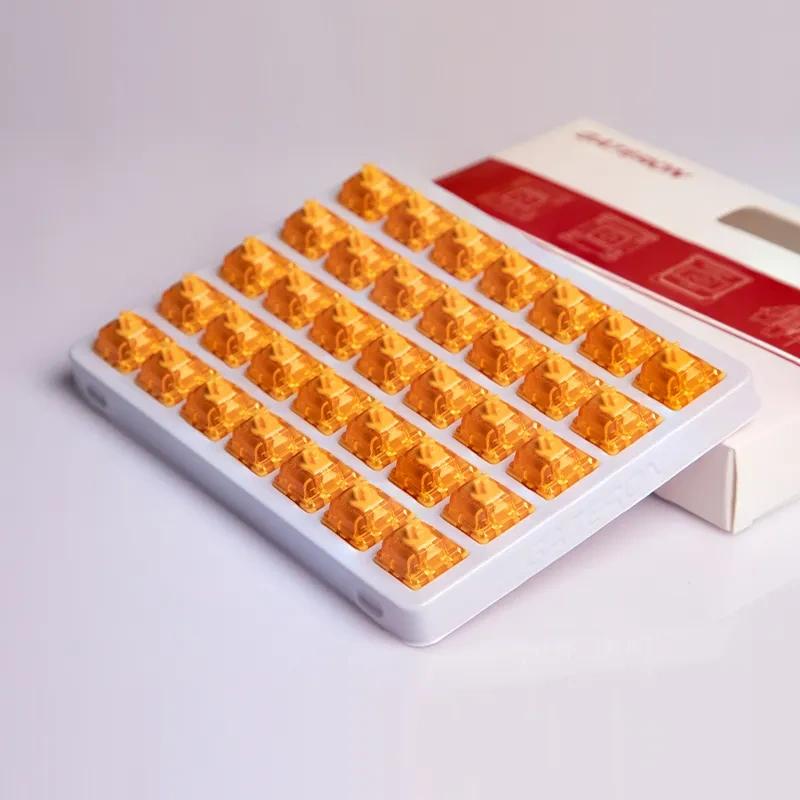
The GATERON KS-20 Magnetic Orange HE Switch Set shows just how far this technology goes for real-world application.
The important things:
- Lifetime: 100,000,000 keystrokes
- Total Travel: 4.1 ± 0.2mm
- Action Travel: Freely settable from 0.4mm to 3.6mm
The durability of KS-20's is due to multiple engineering decisions, and the following all come together to achieve the result:
🔹 Patented Hall effect induction: GATERON has an "Invention Patent" for their induction magnetic technology for mechanical keyboard switches. This is unique, proprietary technology.
🔹 No leaf or pin contact: In this case, there's no metal leaves, contact pins, or any other physical elements that degrade. As it stands, the only moving element is the stem.
🔹 Factory pre-lubed: This means that with travel friction remaining minimal, and the contact points between the stem and housing being consistent and low.
🔹 20mm spring with a POM stem: Precision engineering with a 20mm spring and a POM (polyoxymethylene) stem provides constant resistance and frictionless, linear travel.
What 100 Million Keystrokes Actually Means for You
- For a gamer playing 4 hours daily and having 100 keystrokes a minute, how the number 100 Million keystrokes adds up is a rough estimate of 8 to 10 years.
- For a programmer who uses a keyboard 8 hours every day, at 60 words per minute, it takes about 12-15 years for a keyboard to wear out.
- For a writer, who produces an output of 2,000 words every day, it takes over 20 years.
There's more to longevity than how long a keyboard lasts. Consistency of performance throughout the keyboard's life is an important factor.
Magnetic switches have no contact points. So, there is no deterioration in how magnetic switches feel when being actuated. Magnetic switches remain the same from the first press to the 100 millionth. There is no "break-in period," and no "worn-out period." There is only smooth, linear keystrokes.
Benefits of Magnetic Mechanical Switches
100 million keystrokes is a long life span for a keyboard, but it's only one of many benefits of magnetic mechanical switches:
- Adjustable actuation point: Users can control the actuation point from 0.4mm to 3.6mm through software with per-key customization.
- Faster response time: Magnetic switches have no debounce delay and achieves response time of 0.1ms which is about 5 to 8 times faster than other mechanical switches.
- No double-click problems: The "double click" problems that affect most mechanical switches can't happen in a contactless system.
- Performance consistency: Magnetic switches don't have exposed metal contacts. This makes them more durable to dust and moisture.
Conclusion: A switch meant to outlast its User.
The GATERON KS-20 Magnetic Orange HE Switch Set is meant to show what modern technology in keyboards is capable of. By eliminating the single point of failure that has limited mechanical switches for decades, GATERON has created a switch that does not wear out in any practical sense.
Whether you are a competitive gamer chasing every millisecond of advantage, a professional typing thousands of words daily, or simply someone who wants a keyboard that will last as long as you need it—the 100 million keystroke lifespan of magnetic mechanical switches represents a genuine leap forward in durability.
The switch may cost more upfront. When replacement costs, consistent performance, and longevity are factored in, the total cost of ownership is very attractive.
100 million keystrokes is more than just a figure. It shows that this switch will last much longer than your keyboard.
FAQs
Q1. Can the 100 million keystroke lifespan be considered immortal?
No switch is immortal; however, 100 million cycles is significantly longer than the lifespan of typical switches, about 15 years of heavy daily usage. Given the Hall-effect sensor operates without wear, the only thing that will wear out is the switch mechanically.
Q2. Will longevity of the switch be affected if the actuation point is adjusted?
The actuation point is set in software, and the only thing that changes is the magnetic threshold, which still leaves no physical contact. The longevity will remain the same.
Q3. Are magnetic switches compatible with normal mechanical keyboard PCBs?
No, Hall sensors will need to be integrated into the PCB, along with sensors. These will not be drop-in replacements of the MX-style switches.
Q4. Is there special software required to access adjustable actuation?
Yes, vendor drivers will be required, or a magnetic adjustable switch configurator. Most major brands also offer this tool for free.
Q5. Are these switches suitable for both gaming and typing?
The adjustable actuation point (0.4mm–3.6mm) lets you set ultra-fast response for gaming and deeper, more deliberate travel for comfortable typing—all on the same keyboard.



