Quiet Mechanical Keyboard Switches are no longer a niche preference for a few office users. In 2026, they are part of a larger shift in keyboard demand, which matters because more buyers now want a keyboard that feels precise but sounds controlled, especially in shared offices, home workspaces, studios, and late-night setups.
At GATERON, we often see one repeated misconception: many users still assume that quiet switches must feel soft, vague, or even mushy. In practice, that is not how modern switch engineering works. A well-designed silent switch can reduce bottom-out and return noise while still preserving clean travel, stable guidance, and a defined keystroke. The difference lies in structure, materials, and tuning.
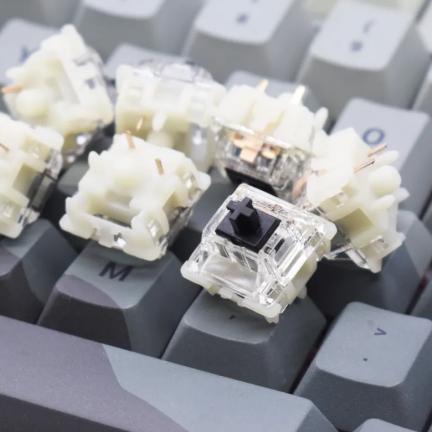
Why The "Mushy" Assumption Still Exists
The idea comes from older or less refined silent switch designs. When sound reduction is added without careful control of travel balance, the result can indeed feel dull. If the dampening element is too intrusive, it may blur the end of the keystroke. If the internal guidance is weak, the keypress may feel loose instead of controlled.
However, quiet does not automatically mean imprecise. What users often describe as "mushy" is actually a combination of poor stem stability, uneven contact feel, or over-soft impact control. A modern silent switch is engineered to avoid that problem. It is designed to reduce harsh noise, not to remove structure.
This distinction is increasingly relevant because keyboard use is expanding beyond gaming communities. As more professionals, creators, and hybrid workers adopt mechanical keyboards, controlled acoustics have become a practical buying factor rather than a secondary preference.
How Quiet Mechanical Keyboard Switches Control Sound Without Losing Feel
The performance of Quiet Mechanical Keyboard Switches depends on how each internal part works together. At GATERON, the goal is not only to make a switch quieter, but to keep the keypress stable and readable.
Three structural ideas matter most:
✓ Slider Rail Stability
The rail system helps guide the stem during travel. Better rail guidance reduces unwanted wobble and keeps the downstroke more consistent.
✓ Dampening At Impact Points
Silent pads are commonly placed to soften the bottom-out and return stroke. This lowers sharp acoustic peaks without removing the full motion of the switch.
✓ Material And Spring Tuning
Stem material, housing composition, lubrication status, and spring behavior all shape how a switch rebounds. A quiet switch still needs energy, control, and a clean reset.
On GATERON's official KS-9 Silent Switch page, the company states that silent pads are installed above and below the shaft core to achieve the mute effect. The same page also notes the use of oxidation-resistant gold contacts for durability, along with compatibility with 5-pin MX mechanical keyboards. This is a good example of silent design done as a full system, not as a single soft insert.
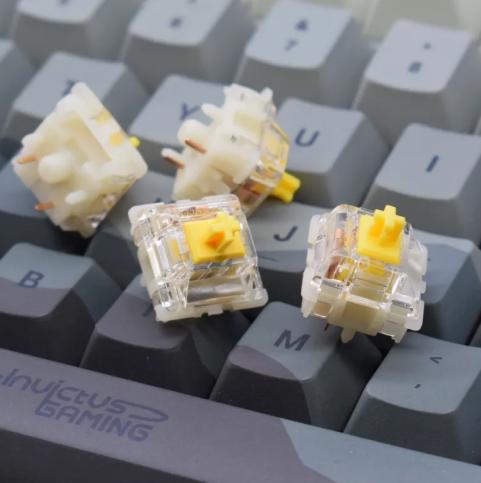
From Slider Rails To Dampening Pads: Where the Real Feel Comes From
When users test a silent switch, they often focus only on sound. Yet the real typing impression comes from motion quality. That is why slider rails matter so much. A stable rail structure keeps the stem moving on a more predictable path. The key feels guided rather than loose. This is one reason modern silent switches can feel far more refined than early market versions.
Dampening pads then manage the acoustic side of the stroke. Instead of allowing a hard plastic-on-plastic impact, they soften the contact at key moments. The key point is moderation. If the pad is balanced correctly, the user still feels the switch complete its motion. The sound becomes quieter, but the action remains present.
At GATERON, silent switch development is not separated from usability. The design logic is simple: remove unnecessary noise, but preserve the mechanical identity of the keypress. That is why quiet switches can still feel responsive in daily typing, coding, and focused gaming.
There is also a practical reason this matters. Research on noise exposure shows that higher noise levels can reduce attention and cognitive performance, which helps explain why buyers increasingly value quieter peripherals in work settings. A quieter keyboard will not solve every acoustic problem, but it can support a more controlled desk environment.
What GATERON Products Show About Modern Quiet Mechanical Keyboard Switches
GATERON's current silent lineup shows that Quiet Mechanical Keyboard Switches now cover different use cases rather than one generic feel. The official Silent Series collection includes products such as the KS-9 Silent 2.0 Switch Set, Zero Degree Switch Fully Silent Set, KS-6 Aliaz Silent Tactile Switch Set, and INK V2 Black Silent Switch Set.
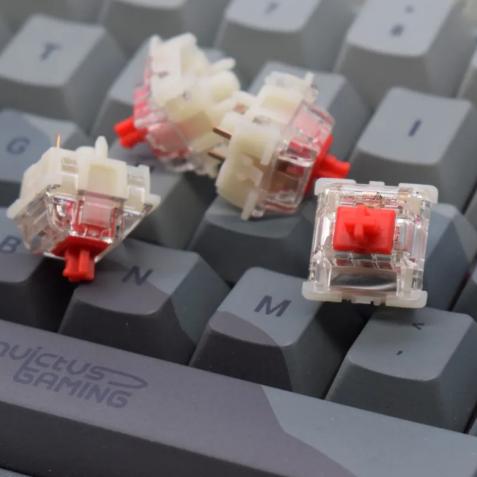
For buyers who want an accessible silent linear option, the Everfree Silent Yellow Switch Set offers a clear reference point. According to GATERON's official product page, it uses a POM stem, PC top housing, nylon bottom housing, stainless steel spring, 5-pin structure, and comes pre-lubed. The product specifications indicate 50±15gf operating force, 2.0±0.6mm pre-travel, and 4.0±0.3mm total travel. The page additionally describes a quieter acoustic signature, matched with smooth keystroke travel and a gentle return effect.
These details matter because they show how silent feel is built from several layers:
✓ Stem material influences smoothness
✓ Housing material affects resonance and stability
✓ Pre-lubing improves motion consistency
✓ Travel and spring values shape control and rebound
In other words, the switch does not feel better simply because it is silent. It feels better when the acoustic solution is matched with strong mechanical fundamentals.
How Clients Should Evaluate Quiet Mechanical Keyboard Switches
For brands, distributors, and keyboard builders, the right question is not "Is it silent?" The better question is "How is the silence achieved, and what does the structure preserves?"
A useful evaluation sequence is straightforward.
First, check whether the switch keeps a clear downstroke and reset.
Second, examine stem guidance and lateral stability.
Third, evaluate the material makeup and whether the switch is pre-lubed or calibrated for production-level consistency.
Then consider the end-use environment. Quiet performance may be relevant for office typing, shared desks, creator studios, and premium keyboard builds, but these applications do not necessarily share the same force or travel requirements.
This is where supplier capability carries real weight. Silent switch quality is built on dependable manufacturing consistency, not just conceptual design. Products are better evaluated when they are supported by transparent specifications, clear segmentation structure, and practical guidance for defined use scenarios.
Why Quiet Does Not Mean Compromise
The silent switch category has matured. Today, Quiet Mechanical Keyboard Switches can deliver a cleaner sound profile without giving up mechanical character. When slider rails are stable, dampening pads are properly balanced, and materials are selected with purpose, the result is not mushy. It is controlled, refined, and commercially relevant.
At GATERON, silent switch development is approached as a precision-focused engineering effort rather than a simple acoustic adjustment. The objective is to preserve the responsiveness and feel of mechanical typing while aligning the experience with the demands of modern environments.
For brands, product developers, and keyboard projects interested in quieter typing performance, this is a strong time to review the newest silent switch structures in depth. Discover GATERON's Silent Series and product specifications to determine which Quiet Mechanical Keyboard Switches best suit office, custom, and performance-oriented use cases.



